An Argument for Anarchy (June 1, 2010)

Anarchy

It’s hard to imagine that the American public has ever felt more powerless in a given period of history than it does now, with the possible exception of the Great Depression. However, even during that awful fiscal and social crisis, there seemed to be a sense of agency – a pull yourself up by the bootstraps mentality that told citizens to wake up and each day and keep fighting. The idea was that if you toiled hard enough after suffering a bad break, recovery was possible.

It’s certainly hard to grab ahold of that sensation now. Millions of jobs have been lost since the “Great Recession” began in 2007. But this time, we sit in the middle of an economic rebound that doesn’t include employment creation. The eliminated positions in finance, construction, manufacturing and other industries may never come back. Companies have learned to do more with less, aided by the technology ironically developed by thousands of H-1 visa workers who find that their services, and thus their vision of the 21st Century American dream, are no longer required.

Oil leaks into the Gulf by the millions of barrels, and we are told this environmental catastrophe may last another couple of MONTHS before we can even begin cleanup. We accept this with a resigned weariness that is beginning to take the shape of a national spirit. We didn’t vote to authorize this deep well drilling, and if there’s nothing the Federal Government can do about it, then certainly John Q. Public can’t solve the problem either. We must all sit our hands and wait patiently for the villain in this nightmare, British Petroleum, to figure a way out of this mess before the Gulf region becomes an ecological holocaust. Fishermen lose their livelihoods, animals die, plants are coated in black sludge and still we must wait for the same non-information to be spoon-fed to us each evening on the nightly news.

Millions of families lost their homes in the housing bust, and their retirement savings in the market crash of late 2008. Individuals and their dependents try to climb out of their personal fiscal craters while Bank of America, Citibank, JP Morgan and other agencies responsible for the mess post more robust profit earnings than ever. The always inept Congress debates punishment while these corporations laugh all the way to the bank.

What is the lesson taken away from these developments as well as the BP saga? Big business, not middle America, is what matters. Most of us can feel free to take a long walk off a short plank for all that our little lives mean in the grand scheme of Federal health. Just ask the families who lost loved ones in the BP oil rig explosion. Their bodies were never found, yet this is not a headline.

Where voices were once heard, raised up to effect a shifting of the national consciousness, and beget change, a organized movement is now required. The Tea Party was written off as a fad until Glenn Beck and his multi-media platform gave it some validity. Candidate Obama’s surge to victory on the shoulders of small donors already seems so antiquated.

So what’s the solution? How do we, to borrow a phrase from the Tea Partiers, “take back America?” How do we return the USA to its heyday as a Republic that is actually run for the people, by the people? Because it seems that preserving the status quo is what has actually become un-American – not as Mr. Rand Paul claims, criticizing the corporations who are slowly breaking our spirits.

The system is shattered and those of us (including me) who were naïve enough to believe that one man as President could fix it, are removing the pixie dust from our eyes to find, to our shock, that we may just need to start from scratch. America has become the proverbial ship that is so off course that it may be sunk before it ever finds the right path.

With each passing day, I am beginning to wonder if that is such a terrible idea to consider.
India’s Double Standard (May 29, 2010)

Instead of jumping right in to make my argument, allow me to relay a personal anecdote which I believe crystallizes the issue.

On Thursday evening, my sister, a connected member of Chicago’s local media, called me as I made my way home from the gym, to relay the first reports of the bomb exploding beneath a packed passenger train in northeast India. The coach was headed for Mumbai, where my in-laws reside, and my thoughtful sister figured I might like to check up on them. As it was 5:00 AM local Mumbai time, I assured my sister that there was no danger of my family being on that train, but the moment I finished that thought, I had another, and it went something like this: “Crap, I am going to have to listen to a three hour diatribe against jihadists this evening.”

Because rightly or wrongly, my initial assumption was that the act of terrorism was the work of Muslim extremists. My husband, an Indian national who has very strong feelings on the long running India/Pakistan conflict, and isn’t shy about sharing them, was likely to be set off anew with this latest crime against humanity. Though he has friends of the Islamic faith, and our beloved brother-in-law, a devotee, is the embodiment of all that is pure and good, Eddie has a tendency to paint the world in broad strokes when incensed.

When he reached home later in the evening, my husband made the inevitable beeline to the computer to get the scoop from his favorite newspaper, The Hindustan Times. I puttered around the house in order to give him a few minutes of breathing room as I braced myself for the verbal onslaught. So imagine my surprise as he emerged from our office, relatively calmly, and headed for the porch to have a cigarette.

Naturally I asked Eddie what was up, and he relayed to me in a composed fashion more or less, that there was nothing to worry about. Because it hadn’t been jihadists who blew up the train after all. No this time, it was the work of the Adivasi National Liberation Army, a fringe, right wing group of Hindus. He relayed this news in a nonchalant fashion, as if reporting that our naughty, but beloved cat had just broken a precious vase. Because you can’t stay angry with your own pet right?

As I felt righteous indignation welling up inside me, I took a moment to gather my thoughts. I then posed one question to Eddie: so it’s OK to ready your war cries against Pakistan when under the impression that they are responsible for the murder of innocent Indians. However, upon learning that the destruction is the work of the majority Hindu population, you feel comfortable shrugging your shoulders and adopting a “kids will be kids” attitude? That was wrong on so many levels I hardly knew where to start.

Eddie is a highly educated man who has lived in the U.S. for eight years. He comes from an upper middle class family that travels the world and could hardly be considered sheltered. My husband follows global headlines, has an inclusive group of friends, and is a fairly forward thinking guy. Yet in the blink of an eye, he downshifted to the tried and true double standard that runs rampant in the highly populous third world nation. Hindus call the shots and Muslims are second class citizens.

And herein might lie the reason, beside the overpopulated cities, unfortified infrastructure and first world economic aspirations, that India is such a frequent target of violence by Muslim extremist groups. The message since long before Gandhi’s time, has been clear. Though there are more Muslims living inside India’s borders than there are in the rest of the Arab world (between 165 and 220 million), Muslims who have lived and died fighting for the nation and its progress, they are, by and large, treated as outsiders by the dominant Hindu majority. This thinking is so ingrained, so institutionalized that a man like Eddie, who has been exposed to much, can’t resist the stereotype.

But even more insufferable to my mind is the idea that, had Thursday’s bombing been the work of anyone else, there would have been a loud baying for the heads of those responsible. Instead, upon discovering that the destruction came at the hands of the Maoist Adivasi National Liberation Army, Eddie launched into a lengthy justification of their behavior, on the grounds of their extreme poverty and frustration with the government. Say what? Pardon me, but we have tons of disenfranchised poor right here in the U.S. These folks do not go about wantonly destroying, and if they did, I hardly think Americans would excuse them on the grounds of their poverty.

But such is India. On the one hand, the nation is growing, economically and socially, at the fastest pace in the world (China gets demerits for atrocious human rights). Yet on the other hand, there is a damaging laissez faire tolerance to the work of backward thinking Hindu groups that sends absolutely the wrong message to minority enclaves. I told Eddie that it was now more than clear to me why Muslims chose to secede and found Pakistan in 1947.

My point is this. My husband is quite representative of the thoughts of Indian citizens, and if anything, he leans farther to the left than most due to his education, experience and residency within a major Western City. Though newspaper reports have described the Adivasi as a “little known militant group,” Eddie tells me that, in fact, these people have been allowed to run lawless, murdering innocent citizens at will for quite some time. Why? Because it is considered politically unpopular to put down a movement, no matter how violent, of the “true” Indians, i.e. Hindus. Why is that thinking acceptable?

Illinois is the New California (May 27, 2010)

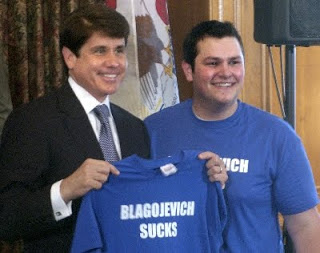
blagojevich-sucks-photo3

Despite what appears to be the inevitable ascent of the Chicago Blackhawks to Stanley Cup Glory (!), those of us in the Prairie State don’t get a win that often. In sports, we are a long suffering people. The Bears have not won anything since 1985, the 1990s glory days of the Chicago Bulls are long gone, The White Sox brought it home in 2005 (but honestly, say what you want, the Sox have never been “Chicago’s Team”), and the Cubs? Well, let’s not go there.

We are the State that brought you the bootlegging empire of Al Capone, as well the long reign of Chicago Mayor Richard J. Daley and “outfit” politics. We are the land of unionized crime, and the entity that has sent two of its last three Governors to Federal prison (once the legal formalities of Blago are complete). Last Fall, we also suffered an embarrassing first round exit from the IOC’s final decision making process to determine the host City of the 2016 Summer Olympics. Ah yes, we have much to be proud of. No wonder we are also known for our drunkeness.

If it appears that I am guilty of conflating Chicago with the State as a whole, that is by design. Downstaters can howl all they want about Illinois being more than just the Windy City, but facts are facts. Chicagoland (City and suburbs) represents more than 75% of Illinois’ population, and roughly the same percentage of its economy. Take Chi-town out of the equation, and we’re left with just another agriculturally centered Red-leaning state.

However, it is not our legacy of losing, corruption, crime and other forms ignominy that I wish to write about today. As a career advocate for human services in Illinois, I would like to call attention to the sorry, pathetic state of lawmaking, and the attempts by the legislature to pass a fiscal year 2011 budget that make the more publicized financial problems of California and New York appear tame.

The Illinois State Senate is preparing to vote on a package, likely by the end of the day, that does nothing at all to address a badly needed increase of revenues. A 1% income tax hike, responsibly proposed by Gov. Pat Quinn, has been shot down over and again, not because lawmakers feel the funds are not needed, but instead because it is considered politically disadvantageous to stand up and do the right thing. The solution, according to these officials, is to attempt to balance the budget, and catch up on backlogged bills, by placing the burden squarely on the shoulders of the social services community – providers who care for children, the aged, the mentally ill, the abused, the homeless and substance abuse addicts. Yes, kick the weak and overworked while they are down. Brilliant!

Under this budget providers will be forced to operate where contracts and funding levels can be changed or cut at any moment. Key points include:

• An Emergency Budget Act that makes funding even more uncertain by giving the Governor unprecedented power (until January 2011) to make additional cuts.

• No human service organization will know about contracts to take affect July 1 for several more weeks, thereby dumping the costs of a quick shut down on the community, clients and staff.

• The Governor will be able to cut budgets at any time.

• There is no solution to late payments; they are simply kicked further down the road.

• There is no comprehensive solution to inadequate human services funding, or the larger issue of the State’s slow descent into insolvency.

If we slice through the political jargon here, what this basically means is that a budget will pass, but no one will know know anything about it until the Governor decides how the money will be allocated. Huh? Last time I checked, the State was not a monarchy. Unacceptable. Don’t we have a right to know where our tax money is going and how it is being use?. Isn’t the point of a budget process to sort all that out upfront? Nope, instead, weak and scared lawmakers are passing the buck right back to Quinn and telling agencies to lobby him for some of those lump sum dollars. What did we hire these people for?

Let’s not wait for the November elections to tell these turkeys how we feel. Call you legislator TODAY and demand better. If you don’t know who your district reps. are, you may access the following website to figure it out:

http://www.elections.state.il.us/DistrictLocator/DistrictOfficialSearchByAddress.aspx

In our cynical age, activism is often derided as both nerdy and pointless. That’s what they want you to believe because if you stay quiet, the status quo can continue unmolested. Let’s demand better Illinois! Let’s show the rest of the nation that we may produce a lot of silly headlines, but we have some backbone too.

A Memo to the Disco Babies (May 25, 2010)

Dear Americans Born Between 1970 – 1980:

This letter is admittedly guilty of mass generalization. However, I have found in my experience that stereotypes are often rooted in truth. The small percentage of you who do not identify with this missive may simply stop reading with my kudos. You have managed to transcend the difficulty of finding a way to responsibly leave your mark between the upwardly mobile Baby Boomer, and the post-Internet DIY entrepreneurship of Generation Y.

To wit: I am sorry to break your hearts, my demographic contemporaries, but you are neither invincible, nor incredibly special as your parents raised you to believe. I am not however, putting the blame for our downward spiral on our folks. We have had 30 years to come to terms with the fact that we are part of a larger society, with responsibilities to our bodies, our minds and our communities. We have singularly failed to do so, despite the benefits of childhood economic stability, modern technology and Prozac.

Those of us born in the 1970s are overweight, under-productive and dying younger. Our life expectancy is shorter than that of our parents, and instead of finding new and creative ways to outstrip their lofty economic and social accomplishments, we are moving back in with our folks in record numbers. We use handheld devices, computers and DVR to dull the mental pain of our stubborn mediocrity, convincing ourselves in the process that we are truth seekers and learners. When that doesn’t work, we take “legal” prescription drugs to make us feel better. If I could do so, I’d send a posthumous memoranda to Heath Ledger, Corey Haim, Brittany Murphy and her newly deceased husband Simon Monjack to find out how well that is faring.

We are becoming our own “lost generation,” living in a virtual reality of disappointment, founded by a sense of entitlement we were never owed, and apparently, do not want to earn on our own merits. What will be our legacy?

As we are becoming parents ourselves, do we accept that we will pass these bad habits, our inert pessimism, our cynical haplessness onto our children? I am concerned about larger issues of national security, the economy and the environment that threaten our global harmony. However, it will require the leadership of the Studio 54 generation to think and plan our way out of these messes, and I am not sure we’re equipped.

Time to wake up. Drop the KFC Double Down and pick up your pride. It’s time to get to work.

Your Colleague,

Becky Boop

A Hiatus From Hooch (May 22, 2010)

drunk

My name is Becky Boop and I am a social binge drinker. I have been afflicted with this evil tendency since the age of 16, the first time I sampled red wine in mass quantities from the liquor cabinet of a high school pal’s parents. That eve I made prank phone calls and fell down the (carpeted) stairs, and the following school day was painful on many levels. This should have been a standard coming of age lesson against the perils of chugging alcohol, especially when you have responsibilities to face the next morning.

Yet this very incident, plus or minus a few details like young age, repeated itself recently, and in fact, I am good for an episode of this nature every few months. Now I recognize the difference between binge social drinking and full blown alcoholism. Alcoholism is a terrible disease that destroys many lives, and has personally affected members of my own family. I can go weeks at a time without touching a drop. My problem is that once I get going, particularly in a lively (or uncomfortable – try that dichotomy on for size) group gathering, I don’t know when to stop. There is a fine line between laughing at all the times I have puked out of cab windows, fallen down or turned in bravura karaoke performances, and backing up to examine if this is really the kind of gal I want to be. There is something decidedly less humorous about these hijinks as one approaches their mid-30s. I have made arguments in the past about the extended adolescence of today’s adults, and in theory I look down upon this. So why in this case am I such a willing contributor?

The shame spiral, physical recovery time and inability to keep my busy life on track after a night of rock star partying is not worth the few hours of fun. On paper, in the sober light of day I am aware of this. I also know that drunkenness affects good judgment. The best way to keep myself out of this trap is to stay away from the sauce completely. I don’t need a drink to have a good time, or do I? Let’s examine the evidence:

1. Last weekend, as I accepted an award from the Illinois Woman’s Press Association, and my nerves were frayed beyond belief at having to endure a public round of applause, I wished for nothing more than a shot of tequila so I could bear my own insecurity.

2. Recently, I was so excited at reuniting with my one of my best friends, traveling abroad from London, I felt the need to down a bottle of wine in 30 minutes so I could keep my tongue in check. I tend to dominate conversations when I am agitated, happily or not, and I am aware this is a turnoff.

3. When I am engaged in a household chore which I do not wish to do, like laundry or washing dishes, I tend to carry a glass of wine with me, and take a sip as a “treat” at given intervals.

Were I to examine this evidence from a purely unemotional, pedagogical perspective, it would seem I use alcohol as a coping mechanism. I do not like the implications of where that behavior leads, especially, as I said, coming from a family where alcoholism has been devastating. I don’t like what I see when I look in the mirror the next morning. But I can turn this self-loathing into a positive. I can take ownership of myself and my social behavior, the way I have co-opted adversity, self-inflicted or otherwise, in the past.

My plan is simplicity itself. Just stop. Stop drinking. Get some distance between myself and the bottle until I can learn to have a healthier relationship with alcohol.

The first test comes tonight. I am having a housewarming party. I am about to leave for Trader Joe’s, where I will stack up on frozen edibles and numerous bottles of wine. Only I won’t touch them. I will greet a parade of guests, pour their libations, and try to find something un-awkward to do with my hands (in the past, clutching and sipping from a wine glass was the answer). I realize that for me, the battle to cure my social binge drinking is about something more than curbing an appetite. It’s about learning to be more comfortable with myself.