Lessons in Lindsanity: Or, How to Wear Orange with Grace (August 3, 2010)

lindsay

Lindsay Lohan’s release from a Los Angeles jail at 1:35 AM yesterday morning, after serving just 13 days of a 90 day sentence, annoys me.

Please tell me how this woman will EVER learn her lesson? And by “lesson,” I do not mean that the hopeless train wreck should have been “scared straight” by her days in the clink, nevermore to find herself on the wrong side of the law. None of us are naïve enough to expect that, and in fact I look forward to the evidence of Lohan’s recidivism with relish. This is, after all, her second trip to the pokey at the ripe old age of 24.

What Ms. Lohan should have learned by now after a dizzying amount of arrests, lawsuits, and video images documenting the rampant drug habit that only she and her mother are delusional enough to deny, is how to besmarter with her lawbreaking. And please Lindsay, if you can’t manage to do that, and insist on sporting “fuck you” nail polish to court, at least have the wherewithal to expect the book to be thrown at you.

But it’s clear, against all logic, that Lohan was genuinely shocked to discover that the laws of the little people also apply to her. Thus the widely circulated You Tube video of Lindsay’s sentencing hysterics on July 7th. This reminds us of the equally humorous “Mommy, it’s not fair!” ejaculations unleashed on the court by Paris Hilton three years ago, before she was hauled away pursuant to a DUI conviction, for a brief stay in the same jail.

Would I be totally perverse if I welcomed the increase in she-celebrity incarceration as evidence of feminist gain? There was a time, not too many decades ago, when ladies were deemed too “soft” to handle the psychological and physical torments of jail, particularly members of the well-to-do crowd. Small crimes committed by women were thus either covered up or ignored, and this might have been fine except for the maddening and condescending implication that female criminals were not self-aware enough to comprehend their actions. Those of us who want equal rights must not cherry pick the situations were they should apply. Therefore, I truly applaud the fine work of the L.A. court system, which has made inmates out of not only Lindsay Lohan and Paris Hilton, but also Nicole Richie, Michelle Rodriguez and a host of other bad girl celebs.

I am pleased to say that Richie and Rodriguez took their lumps like the tough girls they are. Lohan and Hilton, as we have already affirmed, not so much. The pathetic lack of fortitude displayed by Lohan throughout her two-week stay in the Big House, punctuated by late night wailing, catatonic despair and the ironic continuation of the drug abuse that landed her there in the first place (Adderall and Ambien among the list of approved “medications”) leads me to dislike her more than the thoughtless and dangerous actions that warranted the initial attention of the 5-0. Though I will never be proud of my own visit to jail in the summer of 1999, I can at least satisfy myself with the certainty that when trouble and I found each other, I dealt with it as a chastened adult.

Before being picked up in the small town of Kentland Indiana, on August 9, 1999 – the day after my 21st birthday – I often wondered what I would do if the moment arrived. If I found myself in hock with the law, would I panic and break down? Kentland (population 1,822), part of Newton County, outdoes Mayberry in stereotype, with its stated distrust of “big city folks.” While driving back from a weekend celebration in Grand Rapids, Michigan, I was pulled over by a Conservation Officer (whom I dubbed “Fish Cop” behind his back), who actually had to call in another patrolman with the authority to arrest me. It is, my friends, a fine thing to have to filibuster and make small talk with the man ruining your day, while he waits for the authorized cavalry to come slap the cuffs.

Because I had just turned 21 and was, by any measure, a complete moron, I was breezily speeding down the highway at a clip of 80 MPH while simultaneously smoking a “happy birthday to me” joint. I was but minutes from the Illinois border, en route to the University campus at Urbana-Champaign, a place where the marijuana laws were much more forgiving to students such as I.

My bad luck to be picked up in Indiana. My worse luck that I had just come from a shopping spree at a renowned head shop in Michigan. When the fish cop asked if he could take a look in my trunk, this is what he found: an 1/8 ounce of weed, a six pack of beer, incense, a new and unused gas mask, three bowls of all materials (glass, wood and stone), and a brand new water pipe (more commonly called a “bong,” for those of you who actually studied in college).

Thus when Fish asked me to pop open my trunk, tipped off as he was by another motorist, I had no recourse other than to approve his request. Unlike Lindsay Lohan, I was not however, taken aback when I found myself snugly encased afterward in a pair of form fitting silver bracelets, and led to the back of a squad car.

I wish I had a copy of my mug shot for posterity but the Newton County jail is pretty stingy about souvenirs. This bad humor did not however stop a bunch of officers from posing jovially with the armloads of contraband they had snatched from my vehicle. They even had the bad taste to enjoy themselves in my line of vision as I was printed and booked. Abu Ghraib anyone? I have oft suspected that not all the “evidence” found its way to the locker that evening.

I cooled my heels in jail overnight, before my angry and embarrassed mother came to bail me out the next morning. My cell mates – three prostitutes and a crack head – could not have received me more cordially had it been their own parlor, rather than county lockup. They handed me the best reading material in their possession, and informed me of the unlimited calls I could make. Things definitely could have been worse.

In the end, I paid a $1000 fine for my indiscretions, and was ordered to perform 100 hours of community service. After a full year of good behavior, my probation period ended and my record was wiped clean. Know why? Because I kept my nose clean (pun intended Lohan!) and didn’t make myself more annoying to the law than I already had. I finished school, paid my debt to society and most importantly of all, didn’t cry about it. I had been caught red handed. What was the point? I won’t say I never smoked pot again, but I sure didn’t indulge while operating a moving vehicle. Lesson learned.

Making a lot of noise over my deserved punishment would have made it that much harder for myself and everyone I loved to put the incident behind them and move on. Do you hear that Lindsay? It’s called taking responsibility. I owed those who believed I was on my way to life as a hardened convict, the strength of character to bear my sentence with a modicum of composure.

I wish she had served the full 90 days of her sentence. Maybe that extra time would have served to break and humble her, which is really what a situation like this requires.

Dirty Dancing: The Classic Story on Stage

I am an unironic fan of 1987 coming-of-age film classic “Dirty Dancing.” In my humble opinion, there have been but two actors within the last 30 years able to pull off a seamless transition between the best in song and dance, and the virile masculinity of a rugged action star. Those two actors are the gone-too-soon Patrick Swayze, and the thankfully still-kicking Hugh Jackman.

There are, of course, many other reasons to love the movie. That soundtrack. Jennifer Grey’s beautiful curly hair. The nostalgia for the early 1960s. But really? “Dirty Dancing” turned Swayze into an icon — deservedly so.

And yet, the film is not without its problems, one of them being its virtual disregard of the Civil Rights era. Sure, heroine Baby Houseman has vague notions of joining the Peace Corps and making a difference, challenging her father to walk the walk of upper middle class white liberalism by accepting her relationship with dancer Johnny Castle. But as Baby herself notes in the movie, as well as in Broadway in Chicago’s production of “Dirty Dancing,” “You told me you wanted me to change the world, to make it better. But you meant by becoming a lawyer or an economist, and marrying someone from Harvard.”

The stage musical, directed in this limited Windy City run by James Powell, attempts to address the sociopolitical shortcomings of the source material in its first act. Making much over Neil Kellerman’s revisionist humanity (in the film, the character is a proud one percenter), actor Ryan Jesse gawkily and charmingly plans a Southern Freedom Ride with several members of the resort staff. There is a community listening of Martin Luther King Jr.’s “I Have a Dream” speech around the vacation bonfire. The scene enriches the fun and frothy experience of the production’s striking and sustained song and dance display.

Alas, those attempts at serious conversation ultimately go nowhere at all in the second act. They are lost in a bewildering rotation of scenery and set pieces, interspersed with small snatches of dialogue from characters who would probably break the metrics functionality of their Fitbits in 2015, there’s so much walking on and offstage. That’s a fair metaphor for my overall assessment of “Dirty Dancing” the stage production: Too busy and unfocused, too much green screen and too much promenade.

The show does have a full awareness of its camp, which is a plus. In an amusing dance training montage, the terrific Gillian Abbott and Christopher Tierney, as Baby and Johnny, move through a series of natural events (swimming, rain, etc.) that simply can’t be staged believably with only lights and moving parts. So the technical team and actors give up entirely and hand the audience a knowing wink, infused with affectionate warmth and respect for its inspiration.

The work is nothing if not faithful to the ’80s cultural phenomenon of “Dirty Dancing.” Most of Baby’s classic wardrobe is carefully re-created by Costume Designer Jennifer Irwin. In fact Irwin does a spectacular job overall capturing the trends and style of the “Mad Men” era, with a modern stage nod to vibrant color. The dialogue is purposefully intact, not withstanding some edits and the addition of scenes that as mentioned, beef up some side characters and attempt to provide historical context.

True fans of the film will enjoy Broadway in Chicago’s mounting of “Dirty Dancing.” And they will be positively overwhelmed by the vocal talent of Jennlee Shallow and Doug Carpenter, who evenly distribute subtlety and show-stopping power in new renditions of standards like “In the Still of the Night (I’ll Remember)” and “(I’ve Had) The Time of My Life.”

But the show has its limits, despite trying to be everything. And that won’t be enough for “Dancing” newcomers. This becomes painfully apparent throughout the production’s second act. A lot less of everything would amount to more.

“Dirty Dancing” runs through August 30 at the Cadillac Palace Theatre, 151 W. Randolph, Chicago, IL. For information or tickets call 800-775-2000 or visit the Broadway in Chicago website.

Carly Fiorina: The Media’s Faux Feminist Alternative to Hillary

carly fiorina

On August 12th, writers Amy Chozik and Trip Gabriel of the New York Times collaborated on an article entitled, Carly Fiorina Emerges as a G.O.P. Weapon Against ‘War on Women’ Charge. In it, they quote Kellyanne Conway, a Republican strategist, as saying, “[Republican] Donors have looked at her as the answer to Hillary.” In a GOP field overrun with misogyny, the perception of Fiorina as Clinton’s conservative foil may partially explain the former’s recent rise in the primary polls.

But calling out the obvious discrimination the former CEO of Hewlett-Packard often experienced at the hands of her male colleagues, hardly makes Fiorina Norma Rae. After Donald Trump’s abysmal references to debate moderator and Fox News commentator Megyn Kelly’s “bleeding” earlier this month, she told Jake Tapper of CNN, “I’ve had lots of men imply that I was unfit for decision-making because maybe I was having my period. So I’ll say it, O.K?”

 Well, I guess that’s good enough for most members of the corporate media. Carly Fiorina once ran a huge business operation. She’s appealing to voters for an opportunity to take on the nation’s most important job, the presidency. She’s a woman. She’s had men behave like asses toward her. Ergo, she’s a feminist.

This narrative is helpful and accessible to the uninspired press and provides an air of undeserved legitimacy to a 2016 Republican campaign notable for its brazen rhetorical assaults on women and brown people. And we thought 2012 was the lowest we could go. Perhaps recognizing that the party is well on its way to alienating a combined majority of voters (again) in a national election, journalists such as Seth McLaughlin of The Washington Times have resorted to sad Jedi mind tricks. He opens a recent piece with this:

For years, a question lingering over the Republican Party has been whether it was ready for a woman to lead the ticket in a presidential election. Now some are wondering whether Carly Fiorina could be the one to punch through the glass ceiling — possibly setting up an all-female race against Democrat Hillary Rodham Clinton.

This fantasy ignores a few inconvenient facts about Fiorina’s anything but feminist record. As part of her stated platform, the failed California Senator opposes a government requirement that would give private sector workers paid leave. This despite the clear fact that the absence of paid leave opportunities disproportionately affects female employees. Fiorina’s position reflects a lack of empathy with the challenges faced by her gender, as well as an ignorance about the way real Americans live. Democratic Senator Kristen Gillibrand of New York was quoted by The Huffington Post as saying:

I think it will overwhelmingly [hurt] her with both male and female Republican voters because overwhelmingly, they all support paid leave…She may just not be aware, she may be in her own world, her own bubble where she can afford child care, she can afford support when she needs it, but her low-wage worker can’t.

Another area of feminist failure for Fiorina? Despite the relatively short 95-year history of female suffrage, she cast ballots in a mere 25 percent of the California elections for which she was an eligible voter. Michael Hiltzik of the Los Angeles Times reprints this explanation from the CURRENT CANDIDATE FOR PRESIDENT: “I felt disconnected from the decisions made in Washington and, to be honest, really didn’t think my vote mattered because I didn’t have a direct line of sight from my vote to a result.” Susan B. Anthony she is not. Nor is she in possession of an iota of self-awareness.

The hypocrisies continue in conservative and unmotivated media efforts to paint Carly Fiorina as a viable alternative to Hillary Clinton’s message of female empowerment: her backward-looking health care policy (Deregulate! Obamacare is destroying us!), opposition to funding for Planned Parenthood. I could go on, but plumbing the depths of Fiorina’s not-feminism starts to get depressing.

She is no more a competitor for the general female vote than Sarah Palin was in 2008. While Fiorina may be less laughably and proudly buffoonish than the former Governor of Alaska, the idea of her as a serious option for women, or voters who care about them, is equally ridiculous.

Sister, Sister (July 31, 2010)

Me and Jen2

I have my only sibling Jen (photo right) on the brain his morning. Though most of our interaction this week took place over text message (she is team iPhone, myself Team Blackberry), with one phone call thrown in, we had a great week by any measure.

On Tuesday, I helped Jen recover a very important document she thought she’d lost for good, by going to the sent folder of an email account I have had since the dawn of mankind. On Wednesday, we exchanged quick hits about the latest act of parental aggravation. On Thursday, we discussed strategy for dealing with negative personal distraction, and made plans to go a Cubs game Monday night. On Friday, Jen texted her pleasure in hearing the Guns ‘N Roses classic “Paradise City” on the radio, and I told her that song was played out.

Jen is a superhuman suburban mother of two wonderful little girls, who also manages to have a pretty awesome broadcasting career. I am a truly citified woman who has chosen to remain childless, instead devoting unconscionable hours to two careers. On paper, there is plenty to distract us from keeping up the kind of contact we always had growing up. And yet every time Jen reaches out to me, or I to her, I feel like a teenager again in wonderful ways I just can’t experience anywhere else. Case in point: Jen and I attended a book signing for blogger Perez Hilton at Borders two years ago. If this damning evidence doesn’t demonstrate our ability to go tween together, nothing will.

This of course doesn’t mean we can’t share serious emotion. On the contrary, Jen and I have been through a truckload of unimaginable things a deux. The book waits to be written on our childhood experiences, and in the meantime we have cried, yelled and wearily lamented in nonjudgmental companionship. We talk about our marriages, Jen’s kids (who truly do little else but amaze) – everything. It is a true gift to have such a friend, someone I would hang out with any day, without the ties of blood.

I know this will sound unbelievably corny, but when I was senior in high school, and Jen a sophomore, we actually chose to have lunch together, with a smattering of our mutual friends, everyday. Smart ass boys used to call us lesbians as we walked around with our arms around each other. Other, less snarky folks, used to mistake us for twins. In fact this still happens.

On the coldest winter day of early 1996, when the air temperature registered 60 below in Chicago, Jen put on a second pair of pants, and every other layer we could find, to brave the elements with me and get to school. She did not have to do this. In the first place classes had been informally cancelled due to the unbearable weather, and in the second, Jen was not a part of the demanding nerd program that I was, which required me to use school resources no matter the climate. She just wanted to keep me company.

I need not belabor the obvious point. Though we are known to have our occasional differences, which do have the capability of devolving into Jersey Shore-style throw downs (we are merely a couple of guidettes at the end of an angry day), I go to sleep at night knowing that nothing can ever really separate me from my sister. She is the coolest person I know, after myself of course.

She needs to stop watching The Bachelorette, though. For real.

Gang Members Get Schooled in the RP (July 29, 2010)

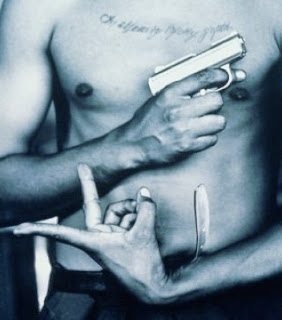
gang-member-signs

I grew up in Chicago, and couldn’t be more proud to call this busy, diverse metropolis my home. Most of my youth was divided between the neighborhoods of Ravenswood (where my tiny Lutheran grade school sat) and Portage Park, where my folks bought a home in 1985. I attended a fairly rough Chicago Public high school, but no venue was better suited to teach me the street smarts that are necessary in life. Instead of lamenting my lot, I celebrated it, somehow realizing that overprotection doesn’t well prepare one for the adult world.

Thanks to my secondary education, I learned a lot more than how to write an essay or dissect a fetal pig. I learned how to jostle myself and my heavy book bag through a tight crowd, without letting the bigger, meaner looking kids intimidate me. I learned how to focus and avoid the distractions of cross clique trash talk. I learned how to look beyond graffiti and grime to appreciate the architecture beneath. Most importantly I learned that all of us kids, regardless of race, religion or socioeconomic status, wanted the same things: good grades, parental approval, freedom and a love life. We also rebelled against the same influences, albeit in our own different ways: authority, convention and the status quo.

Though there were some dicey and violent incidents that occurred on school grounds, I developed a sixth sense for staying away from trouble, in ways I might not have had I attended a more pristine institution. Gang activity was always around, but if you steered clear of the people sucked into that world (and you well knew who they were), everything was copacetic. I learned to feel sorrow, rather than disdain, for the peers who found their lives over before they really began- often from broken (and notably fatherless) homes, victims of world weary hopelessness at an age that should be flush with promise and opportunity.

Several months ago, I relocated with my husband to the lake front neighborhood of Rogers Park. This area, from the 1970s until fairly recently, was well known as one of the most dangerous places North of downtown. But like every other waterfront locale in Chicago, Rogers Park has enjoyed a boom in development and gentrification. However, this economic rise is exclusive, and one of the many reasons I take issue with the policies of Mayor Daley. It is not difficult to walk the streets and encounter the faces of those who have been left behind: the homeless and mentally ill who line up to solicit change from commuters disembarking the Red Line, the pre-op transsexual, shabbily made up, and furtively looking for love at the local bars, the exhausted mother with five children who walks down the street, heavy with grocery parcels paid for with limited WIC card means.

Part of the reason I was drawn to the area is that it reminded me so much of my high school experience. But now, unlike then, I am in a position to advocate on my neighborhood’s behalf. I am enjoying the diversity, the richness of my daily experience and I do not want to see people with limited opportunity and resources driven from the area. Through my day job as an activist for human services, my involvement with the Rogers Park Business Alliance, and through connections with the local alderman’s office, I am striving to make sure that the wealthy white collar crowd doesn’t make diversity an endangered species.

However, just as it was in high school, gang activity in the area threatens to encroach upon the collective peace of mind, and efforts to uplift the community. As a student, as I mentioned already, I knew who the players were and how to keep my distance. I do not always have this same benefit today.

On Tuesday night, around 9 PM, not an hour after alighting from the train and walking through my front door, on the same street that serves as playground to scores of unburdened neighborhood children enjoying long summer hours, two rival gangs (the Latin Kings and the Grand Disciples – well known to residents of Chicago) decided to open fire on each other on the crowded block. After talking with my neighbors, I learned that the melee was started over the same tired “turf wars” that have always accompanied gang activity. I am happy to report that no civilians were injured in the event, but that was just dumb luck, rather than deliberate consideration on the part of enemies, who might otherwise be friends if not for the brainwashing of their organizations.

I stood on my porch watching as Chicago’s finest chased, and then apprehended the gunman. This was met with a loud whoop of approval from my apparently fearless fellow citizens. A few brave and sporting souls even assisted the police by loudly tracking the suspect’s movements. The victim was loaded into an ambulance, and witness statements taken, before the police moved onto to deal with the next violent crime.

These bystanders, my neighbors, were the true heroes of the evening. Not only did they set aside concerns for their own safety to aid and abet the law, but they stood their ground on that street corner – at times the crowd six people deep. They were sending a message to those who would engage in violent crime: “This is OUR turf damn it and we are not afraid of you!” Is it any wonder I love the neighborhood?

The recent Supreme Court decision to strike down Chicago’s handgun ban, and the City cash crunch that is increasingly forcing the layoff of public servants, seems to suggest that incidents like Tuesday’s may become more frequent. I already overheard some of the people in my building (notably white and upper middle class) discussing plans to relocate. That would be a shame. Stay and hold your ground. Learn through exposure, as I once did, not to let the bigger, meaner kids intimidate you.