The Christians

pastor-paul
Tom Irwin stars as Pastor Paul

K. Todd Freeman, Steppenwolf ensemble member and Director of “The Christians,” is one of the most important talents to be found among Chicago’s robust theater community. As an actor (Tony-nominated for 2014’s “Airline Highway”) and maestro (2012’s electric “Good People”), Freeman influences projects that refract sociopolitical and spiritual dynamics into fascinating onstage shapes.

And he’s done it again with the Windy City premiere of playwright Lucas Hnath’s 2015 work, “The Christians.” Press materials describe the production as one of “great complexity and passion [which looks] at the relationship between belief and behavior… [an] evenhanded, unbiased take on faith in modern America.”

The work can be appreciated agnostically, though it is clear from auditing the Book of Job-esque cautionary tale of a righteously compromised man, that Hnath has read his Bible. And under the direction of Freeman, a Deacon’s son, a tortured, and at times wistful portrait of theology and fellowship is brought to life.

Pastor Paul (a layered and deft Tom Irwin) is the man with everything — the beautiful, devoted wife (Shannon Cochran), a growing congregation and a newly debt-free church. The preacher is the spiritual leader of thousands, a man seemingly in command of traditional morality infused with 21st Century humanistic flexibility.

One fine Sunday, Pastor Paul confidently takes his place at the lectern to articulate a “new belief in the nature of salvation.” What could go wrong with sharing a more inclusive interpretation of forgiveness?

In short and without spoilers, just about everything. Yet because of Hnath’s subtle, graded writing, Freeman’s careful direction and a number of top-drawer acting performances, there are no finite answers. If the audience is left with more questions than certainty by curtain call, that’s precisely the point.

After all, saints and sinners are rarely as straightforward as their neat categorizations imply. “Schism” is a word carefully chosen in the dialogue as well as the work’s plot summary. As Pastor’s Paul’s congregation and spiritual authority are tested, relationships viewed as unwavering from an outsider’s perspective begin to splinter.

Veteran actress Jacqueline Williams delivers a shattering profile of structural and personal crisis. As Jenny, a believer who feels betrayed and deceived by her pastor’s evolution, the artist conveys a desperate need for simple, clear direction. As an audience member, it’s impossible to remain unmoved by Williams’ vulnerability.

Jenny has struggled, suffered and given so much that her weary pleas for accessible duality — heaven/hell, Jesus/The Devil — feel less like judgmental denunciation and more like bereft confusion. Through Williams’ tears and soft speech, we hear Jenny’s accusation loud and clear, “I have burdens enough to carry. You were supposed to take this one, Pastor Paul.”

Tom Irwin, a 1990s pop cultural legend for Generation Xers, is the understated glue that holds the powerful cast together. Many fans will find parallels between Pastor Paul and Graham Chase, the complicated television dad Irwin played on ABC’s “My So-Called Life.” Both characters appear to have it all, but are cut off from enjoying their earthly bounties by self-destructive streaks that may or may not indicate a misguided allegiance to personal over public morality.

Why did Pastor Paul unburden his soul that fateful Sunday morning? Was he really bidden by the voice of God, or was he victimized by his own hubris, the freedom of speech and direction permitted by a mortgage bill paid in full? Audience members will never be more certain than the conflicted Jenny, or Pastor Paul’s wife, who wonders about the implications for her own spirituality pursuant to her spouse’s epiphany.

What audiences of “The Christians” can say with certainty is that the conversion of Steppenwolf’s Downstairs Theatre into a church with a live pre-show choir packs a powerful, authentic punch that sets the production’s tone. Veteran Scenic Designer Walt Spangler evokes the feel of a cavernous megachurch juxtaposed with the intimacy of direct spiritual conversation.

And chorus members Williams, Faith Howard, Yando Lopez, Leonard Maddox Jr., Jazelle Morriss, Mary-Margaret Roberts and Charlie Strater take viewers to the metaphorical mountaintop (regardless of belief) with soaring, passionate vocals that demand clapped hands and movement.

With an 80-minute running time and no intermission, “The Christians” is quickly paced, deeply felt and worthy of a spot on your 2016/2017 winter theater calendar.

“The Christians” runs through January 29, 2017 at Steppenwolf Theatre, 1650 N Halsted Street, Chicago, IL. For information or tickets, call 312-335-1650 or visit the Steppenwolf Theatre website.
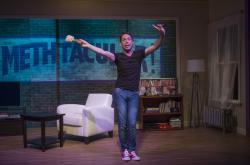


Methtacular

meth
Steven Strafford

Steven Strafford, the creator of one-man show “Methacular,” has left an indelible 2016 imprint on the Chicago theater market — and this critic. I had the pleasure of seeing him inhabit the role of dastardly, but ultimately redeemable editor Chick Clark in the Goodman Theatre’s smash musical production “Wonderful Town” earlier this fall. In that guise, Strafford was all lovely song and dance in a welcome early 20th Century meditation on foiled patriarchy.

Where “Wonderful Town” contained cotton candy set pieces and a mostly wholesome view of New York City in the 1950s, Stafford’s autobiographical work in “Methtacular,” is, shall we say, a departure? Very unfortunately, the show just concluded a limited two-night engagement as part of Steppenwolf Theatre’s LookOut Series. However, this past weekend was not the first Chicago mounting of the work and perhaps if theatergoers ask Strafford very nicely, it won’t be the last.

Press materials describe “Methtacular” as follows: “Through comedy, songs, and plenty of honest storytelling, Strafford brings audiences on a journey through the chemical highs, devastating lows, and ultimate redemption from his drug addled, sex crazed life.”

Seemingly against rational logic, “Methtacular” is exactly the triumph over tragedy night of good fun a battered American electorate needs. It’s true. I feel personally fortunate to have seen the show last Friday night. A mere three days after the once improbable triumph of Donald J. Trump over Hillary Clinton to become our nation’s President-elect, I felt I might never laugh again.

Like so many other shell-shocked and concerned citizens, I spent the previous 72 hours in withdrawal, afraid for the future of our democracy and so many of its demographics: the LGBTQ community, Muslims, immigrants in general, women. Pretty much everyone.

“Methacular” is a jolt of honesty, self-deprecation and entertainment that offers hope, even where the emotion ought to be in short supply. As Strafford wastes no time telling a rapt cabaret audience, he was a capital “M” mess before he grew into the celebrated and acclaimed performer Chicago knows today. Once upon a time he was a virginal Jersey boy, a budding performer new to our Midwestern shores. A young man who found himself lost in a drug clouded world of bathhouses, physical danger, deception and crime.

By all accounts during the 75-minute show, we ought to be speaking of Strafford in the past tense. One such testimonial is offered by Steven’s mother through a series of poignant, heartbreaking video clips. There is much to take seriously about the helpless experience of watching a loved one kill themselves in slow motion.

Yet the poignancy is a conduit to redemption. Strafford and his Director Adam Fitzgerald take great pains to step in all the ugliness — to bring the audience to an uncomfortable climax. And yet Strafford’s winning stage presence, his song, humor and visible health give away the ending right from the start. He is more than ok. He’s thriving. It’s fine to let loose and laugh at the absurdity of near death.

And there are plenty of laughs to subvert the darkness. Strafford directly engages the audience — with eye contact and by literally including members in some of the sketches. The performer brings something special to this stunning and entertaining confession. He knows that we know what it’s like to struggle with addiction, or to watch the disease take hold of a friend or a family member. It’s a heartbreakingly universal experience and yet through pain, there is always, forever, humor.

As we approach a time of great economic, social and judicial insecurity, “Methacular” doesn’t offer any easy answers. As Strafford says toward the end of the show, he’s not sure why he stayed in New Jersey and got sober at last. He “just did.” It’s as arbitrary an admission as it is inspiring. Perhaps it’s true of human nature that invariably, we get sick of being stuck and isolated. And we can laugh at ourselves on the path to enlightenment.

“Methtacular” ran through November 12 at the Steppenwolf 1700 Theatre, 1700 N Halsted Street, Chicago, IL. For information or tickets, call 312-335-1650 or visit the Steppenwolf Theatre website.

Wonderful Town

wonderful-town
Jordan Brown (Wreck), Kristin Villanueva (Helen), Bri Sudia (Ruth) and Lauren Molina (Eileen)


Last year I went with a close friend to see a staging of “Carousel” at the Lyric Opera in Chicago. A rare Broadway turn for the famous venue, I was excited by the certain high-quality production values as well as a first viewing of the Rodgers and Hammerstein classic.

Oh the misogyny! I should have read the script before purchasing a ticket. I was not on critic duty that evening, just trying to enjoy a civilian evening at the theater. And I understand that the material was adapted in 1945 — certainly a different time for American gender relations. I can appreciate that perspective, but I’m just the wrong cat to indulge the sexist horror that is Billy Bigelow — in life and in death. While my pal wept at the production’s well-acted emotional denouement, I wanted to break the third wall for a serious feminist discussion with Julie Jordan.

So when I accepted an invitation to see and review “Wonderful Town,” the latest Mary Zimmerman-helmed production at the Goodman Theatre, I braced myself. The 1953 Tony Award-winner for Best Book of a Musical features 20 songs created by the legendary Leonard Bernstein. The music almost guaranteed to win, I scoffed at the brief plot synopsis. “Two sisters, one city, unlimited possibilities.”

Let me guess: another dated New York love story. Two female siblings, one beautiful and destined for great love, the other creative and intelligent but certainly a supporting character overlooked by the opposite gender. Each woman bound to be defined by male relationships.

I’m eating my prejudices as I type, washing down the cynicism with a refreshing glass of water. Because “Wonderful Town” was — and remains — a creation ahead of its time. Imagine if Lucy and Ethel were unmarried, career ambitious and in possession of more love and loyalty for one another than any man could equal. Think “Sex and the City,” post-WWII style (without the sex).

This is the story of elder sister Ruth, a budding fiction writer and reporter, and Eileen, an ingénue yearning for her big performance break. Director Zimmerman places the action in 1950s Greenwich Village rather the original Depression-era and it’s a great choice. Distant from post-1929 panic with its physical and cultural hunger, Set Designer Todd Rosenthal gives us a dreamlike, cotton candy land of artistic community. Yet the pieces remain functional and when necessary, convey the grime of a working class Big Apple.

What’s not grimy at all are the gorgeous costumes from Designer Ana Kuzamanic. The flounce and color are a perfect match for the rotating set. Even the frumpiest chorus characters are infused with enchanting whimsy.

It would be misleading however, to interpret all the fun shades and soft lighting as a statement of one-dimensional simplicity. No indeed. Ruth (Bri Sudia) and Eileen (Lauren Molina) are much more than their humble Midwestern roots and wide-eyed city freshness imply. They may wonder in song why oh why-o they ever left “Ohio,” but these gritty girls aren’t afraid of a little rejection, mansplaining or even jail time, in their determination to make it.

With delight it eventually dawned on me that Ruth is the main character of “Wonderful Town.” Infused with the power of the pen and far from man hungry, Ruth routinely sets her pride aside in the quest for a good story or better opportunity. I have already said that this work is ahead of its time. Spoiler alert: though she does end up paired with a partner, it’s one who needs her far more than she depends on him.

The soundtrack is delightful, no surprise given the Bernstein legend. Standouts include “One Hundred Easy Ways,” a humorous look at female empowerment as a detractor for the conventional man, and “Pass the Football,” a prescient treatise on celebrity culture.

At over two and a half hours with one brief intermission, “Wonderful Town” is on the longish side. However time flies with all the visual, audio and performance stimulus keeping the audience moving. It’s not a perfect show and there’s certainly some standard musical comedy deus ex machina to tidy the ending. That’s about the only convention viewers will find. Enjoy the precocious, lovely ride.

“Wonderful Town” runs through Oct. 23 at the Goodman Theatre, 170 N Dearborn Street, Chicago, IL. For information or tickets, call 312-443-3800 or visit the Goodman Theatre website.


Ultra American: A Patriot Act

usman
Azhar Usman

Silk Road Rising is doing something unique and exciting on the Chicago theater landscape. Per its website, Silk Road “tell[s] stories through primarily Asian American and Middle Eastern American lenses. In representing communities that intersect and overlap, we advance a polycultural worldview.” Although the mission is presented in this way as demographically specific, the company’s quality work appeals to all artistic cohorts.

My last Silk Road experience was back in 2011 with the Chicago premiere of David Hwang’s “Yellow Face.” Part memoir, part fiction, the production was consistent with the company’s brand: stories of relatable American culture intertwined with the global community and world history. To be part of a Silk Road audience is to be entertained — and educated. It’s never a bad thing when good work also leaves one better informed.

I had to view “Ultra American: A Patriot Act,” the one-man show from American Muslim comedian Azhar Usman to learn, for example, that there are less than 16 million Jews on the planet. This seemed impossible, especially to a native of Chicago where Jewish culture is prominent and rich. So I Googled it on the way home. Sure enough, 70 years after the Holocaust, population numbers of the beleaguered people have yet to regain pre-World War II levels.

I should have wept over this revelation but I was too busy laughing at Usman’s description of growing up in Skokie, attending so many bar mitzvahs that he became jealous of the “chosen” people. The man labeled “America’s Funniest Muslim” by CNN also manages to turn a life spent profiled by airport security and fellow passengers into a laugh riot.

“Ultra American” is “good, but not great,” as my companion for the evening accurately put it. But the periodic giggles and opportunity to understand how Muslims grapple with the double consciousness forced upon U.S. people of color? Well worth the reasonable $25 ticket price.

What keeps the production from being great is a phenomenon that Usman focuses upon at the end of his 80-minute set: “projection.” While sharing gallows humor vignettes about the life of a traveling comedian who matches the physical stereotype of a terrorist, Usman concludes that everyone’s story involves projecting our attitudes, prejudices and experiences on another. It’s a solid philosophical point.

The problem comes early in the show when the performer levels some tough accusations at white Middle America, which frankly he must. After all, this is the year in which Donald Trump rose to become the alt right, hate-filled standard bearer of the Republican Party. This did not occur overnight or in a vacuum and Usman could not reasonably be expected to avoid racism. It would be a dereliction of duty.

What’s interesting however is the number of times he directly addresses white audience members and tells them to “relax” or “laugh,” claiming to feel rising tension in the room. Ironically, this is an act of projection that reveals the performer’s own biases. It is he who appears to be uncomfortable indicting certain segments of Caucasian culture, when it must be clear that bigots of any kind are unlikely to purchase a ticket to his show. Moments of genuine community laughter were sometimes met with an abrupt end by a weird strain of defensiveness.

As the production runs through September 25, there is still time for Usman to refine his approach. Don’t anticipate controversy for the audience. Trust them to get there on their own, and laugh at the absurdity of it all.

“Ultra American: A Patriot Act” runs through September 25 at the Chicago Temple, 77 W Washington Street, Chicago, IL. For information or tickets, call 312-857-1234, ext. 201, or visit the Ultra American website.

Kinky Boots

Kinky Boots

Because I have apparently spent the last four years living in a musical theater trunk, I knew shockingly little about six-time 2013 Tony Award-winner “Kinky Boots.” With keen interest I was aware that the show is scored by 1980s pop music legend Cyndi Lauper and that the plot has something to do with shoes. Touring productions have passed through Chicago several times but somehow I always missed them.

I am pleased to report that this bit of Broadway ignorance has been rectified. Directed and choreographed by Jerry Mitchell, with a book by Harvey Fierstein, “Kinky Boots” is back in town at the Oriental Theatre for a limited one-week engagement. Fierstein, who recently disappointed me with the one-dimensional Disney musical “Newsies,” returns to fine narrative form with the story of Charlie Price and Lola. The plot summary per press materials is as follows:

“Charlie Price is struggling to live up to his father’s expectations and continue the family business of Price & Son. With the factory’s future hanging in the balance, help arrives in the unlikely but spectacular form of Lola, a fabulous performer in need of some sturdy new stilettos.”

This is accurate and yet, as opposed to the oversimplified “Newsies,” “Kinky Boots” is full of loaded, complicated questions. Can legacy craftsman stay alive in the modern commercial world of outsourcing? How are the relationships between fathers and sons shaped by expectation and ambition? And what exactly does it mean to “be a man?”

Not all of these queries are given clear answers and that’s as it should be. What the source material and strong performances do assert however is that manhood is actually a wide variety of profiles in courage, personalized for every individual. And Lola, a trained prize fighter, loving human and drag queen extraordinaire defies all stereotype to present an engrossing, complex, emotional portrait of maleness.

While Billy Porter originated the role on Broadway, Lord have mercy J. Harrison Ghee. The actor, best known for a regional production of “The Color Purple” is a force of nature. Stunningly good looking, powerful of movement and with a soaring, gorgeous voice reminiscent of a young Luther Vandross, this is Ghee’s stage and he knows how to command it. The artist is no slouch in the dramatic department either. Just try not to weep at the conclusion of “Hold Me in Your Heart” toward the end of the second act.

The cast is not as uniformly and uniquely gifted as Ghee. Adam Kaplan’s Charlie is cute and likeable, but the performance is a quick, pleasant consumption, unlikely to stay with the audience longer than it takes to process the sugar rush. And it’s kind of hard to understand why stage and television screen icon Jim J. Bullock would undertake the largely throwaway role of George, the Price family accountant. He has a couple of good moments but his larger-than-life “Too Close for Comfort” personality is buried under a frumpy costume and rote dialogue.

Tiffany Engen, as dedicated Price employee and Charlie-smitten Lauren fares much better. She is a talented physical comedienne who uses every millimeter of her short stature to project an endearing, quirky foil to Charlie’s social-climbing, materialistic fiancée Nicola (Ellen Marlow).

As for Lola’s parade of “Angels,” a chorus of drag amazingness embodied by Joseph Anthony Byrd, Sam Dowling, Ian Gallagher Fitzgerald, JP Qualters, Xavier Reyes and Sam Rohloff, there’s almost literally no words. Their physiques, costumes, acrobatics, sass, and strut are both an extension of Lola and a magnificent entertainment standalone. The musical numbers that conclude both acts — “Everybody Say Yeah” and “Raise You Up/Just Be” — would have much less punch without this group of rhythmic, sexy performances.

Cyndi Lauper earned every piece of metal that went into creating her Tony Award for Best Score. Each carefully crafted tune is a catchy, touching story, seamlessly serving plot movement while working just as well as party playlist addition. The soundtrack will be on my holiday gift list this year.

There are some minor details with which a critic could quibble. The second act argument between Charlie and Lola feels a bit contrived and some of the rural England factory characters are shallowly drawn. But really, who cares? “Kinky Boots” is one hell of a show. Chicagoans are encouraged to catch it before it sashays back out of town.

“Kinky Boots” runs through September 4 at the Oriental Theatre, 24 W. Randolph Street, Chicago, IL. For information or tickets, call 800-775-2000 or visit the Broadway in Chicago website.