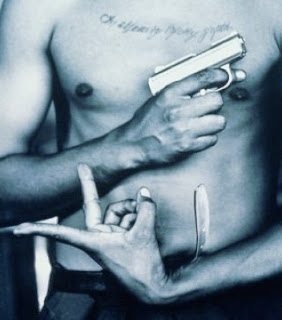
Gang Members Get Schooled in the RP (July 29, 2010)

gang-member-signs

I grew up in Chicago, and couldn’t be more proud to call this busy, diverse metropolis my home. Most of my youth was divided between the neighborhoods of Ravenswood (where my tiny Lutheran grade school sat) and Portage Park, where my folks bought a home in 1985. I attended a fairly rough Chicago Public high school, but no venue was better suited to teach me the street smarts that are necessary in life. Instead of lamenting my lot, I celebrated it, somehow realizing that overprotection doesn’t well prepare one for the adult world.

Thanks to my secondary education, I learned a lot more than how to write an essay or dissect a fetal pig. I learned how to jostle myself and my heavy book bag through a tight crowd, without letting the bigger, meaner looking kids intimidate me. I learned how to focus and avoid the distractions of cross clique trash talk. I learned how to look beyond graffiti and grime to appreciate the architecture beneath. Most importantly I learned that all of us kids, regardless of race, religion or socioeconomic status, wanted the same things: good grades, parental approval, freedom and a love life. We also rebelled against the same influences, albeit in our own different ways: authority, convention and the status quo.

Though there were some dicey and violent incidents that occurred on school grounds, I developed a sixth sense for staying away from trouble, in ways I might not have had I attended a more pristine institution. Gang activity was always around, but if you steered clear of the people sucked into that world (and you well knew who they were), everything was copacetic. I learned to feel sorrow, rather than disdain, for the peers who found their lives over before they really began- often from broken (and notably fatherless) homes, victims of world weary hopelessness at an age that should be flush with promise and opportunity.

Several months ago, I relocated with my husband to the lake front neighborhood of Rogers Park. This area, from the 1970s until fairly recently, was well known as one of the most dangerous places North of downtown. But like every other waterfront locale in Chicago, Rogers Park has enjoyed a boom in development and gentrification. However, this economic rise is exclusive, and one of the many reasons I take issue with the policies of Mayor Daley. It is not difficult to walk the streets and encounter the faces of those who have been left behind: the homeless and mentally ill who line up to solicit change from commuters disembarking the Red Line, the pre-op transsexual, shabbily made up, and furtively looking for love at the local bars, the exhausted mother with five children who walks down the street, heavy with grocery parcels paid for with limited WIC card means.

Part of the reason I was drawn to the area is that it reminded me so much of my high school experience. But now, unlike then, I am in a position to advocate on my neighborhood’s behalf. I am enjoying the diversity, the richness of my daily experience and I do not want to see people with limited opportunity and resources driven from the area. Through my day job as an activist for human services, my involvement with the Rogers Park Business Alliance, and through connections with the local alderman’s office, I am striving to make sure that the wealthy white collar crowd doesn’t make diversity an endangered species.

However, just as it was in high school, gang activity in the area threatens to encroach upon the collective peace of mind, and efforts to uplift the community. As a student, as I mentioned already, I knew who the players were and how to keep my distance. I do not always have this same benefit today.

On Tuesday night, around 9 PM, not an hour after alighting from the train and walking through my front door, on the same street that serves as playground to scores of unburdened neighborhood children enjoying long summer hours, two rival gangs (the Latin Kings and the Grand Disciples – well known to residents of Chicago) decided to open fire on each other on the crowded block. After talking with my neighbors, I learned that the melee was started over the same tired “turf wars” that have always accompanied gang activity. I am happy to report that no civilians were injured in the event, but that was just dumb luck, rather than deliberate consideration on the part of enemies, who might otherwise be friends if not for the brainwashing of their organizations.

I stood on my porch watching as Chicago’s finest chased, and then apprehended the gunman. This was met with a loud whoop of approval from my apparently fearless fellow citizens. A few brave and sporting souls even assisted the police by loudly tracking the suspect’s movements. The victim was loaded into an ambulance, and witness statements taken, before the police moved onto to deal with the next violent crime.

These bystanders, my neighbors, were the true heroes of the evening. Not only did they set aside concerns for their own safety to aid and abet the law, but they stood their ground on that street corner – at times the crowd six people deep. They were sending a message to those who would engage in violent crime: “This is OUR turf damn it and we are not afraid of you!” Is it any wonder I love the neighborhood?

The recent Supreme Court decision to strike down Chicago’s handgun ban, and the City cash crunch that is increasingly forcing the layoff of public servants, seems to suggest that incidents like Tuesday’s may become more frequent. I already overheard some of the people in my building (notably white and upper middle class) discussing plans to relocate. That would be a shame. Stay and hold your ground. Learn through exposure, as I once did, not to let the bigger, meaner kids intimidate you.

Why Are We Debating the Civil Rights Act in 2010? (July 27, 2010)

Ronald Reagan

I have a close friend, whom I will call David for the purposes of this post, who presents me with an intellectual challenge. David is a well-informed 26 year-old African American man, and an unrepentant capitalist, Libertarian and disciple of Tea Party guru Ayn Rand.

Though David is a Libertarian in the philosophy’s purest form, i.e. a believer in equality and opportunity for all who supports gay marriage, and applauds female momentum in the workplace, he also finds himself in agreement with the likes of Rand Paul, a Tea Party candidate for the Kentucky Senate, who once mentioned that the Civil Rights Act of 1964 represented the continual overreach of the Federal government. Now I am a very opinionated person, as you may have noticed, but I am not fond of surrounding myself with homogenous head nodders. My quest, as it always has been, is to learn and discuss. Obviously, my friendship with David is fertile ground for this mission.

Over lunch one day, I asked, incredulously, how on Earth a black man could stand in opposition to the Civil Rights Act?! His response, as logically explained as it was subversive, took on a decidedly Bill Cosby slant. His complaint was that an attempt to equalize opportunity for the African American community has instead enfeebled it, viewing as David does, that the Civil Rights Act is the parent of the current welfare system. Now one can take issue with that position, as I certainly did, but one of the things I like most about David is not only his fearless individualism, but the well researched way in which he defends his beliefs.

At one point in our tete a tete, I flatly asked David the following question: “If Tea Partiers are Libertarians, lovers of personal freedom and deregulation, shouldn’t they be foursquare behind the gay community, as it continues its fight to participate in legal marriage?” David, who is quick to dissociate himself from the Tea Party Express, claiming with certainty that its members “don’t understand their own ideology,” agreed and pronounced furthermore, much as the NAACP did several weeks back, that the populist group should also disown the patently racist elements within its own ranks.

Much later, as I mulled over the content of this calmly spoken, but contentious personal debate, I found myself returning again and again to Shirley Sherrod. By now, most of us are aware of the tragic hatchet job performed on the tireless senior member of the USDA. Conservative blogger Andrew Breitbart embarked, two weeks ago, on a disingenuous exercise in “gotcha journalism,” an attempt to defend the Tea Party from accusations of racism that instead only underscored the malevolent underbelly of the movement. This suspect and utterly partisan “news source” was able to single handedly humiliate an innocent woman, along with the entire White House and our national media apparatus, as though the latter isn’t already doing that well enough on its own. I will never forget, much to my chagrin, that I first heard the “story” of Sherrod’s supposedly racist remarks at an NAACP event, from Anderson Cooper.

My quest here is not to vilify pop culture’s lazy detection skills. Plenty of pundits, bloggers and journalists are already handling that. Instead my question, as relates to my conversation with David, is to wonder if we would have ever completely grasped the depths of injustice meted out to Shirley Sherrod WITHOUT the Civil Rights movement of the 1960s? As author Joan Walsh writes in her essay, “The Civil Rights Heroism of Charles Sherrod:”

“People who care about civil rights and racial reconciliation may eventually thank Andrew Breitbart for bringing Shirley Sherrod the global attention she deserves. Really. Her message of racial healing, her insight that the forces of wealth and injustice have always pit ‘the haves and the have-nots’ against each other, whatever their race, is exactly what’s missing in today’s Beltway debates about race.”

Point taken, Ms. Walsh. It is quite ironic that Breitbart set his smear in motion, using one of the few everyday American citizens who can point to a formidable historical record in her defense. And without the Civil Rights Act of 1964, would Mrs. Sherrod have ever held her position at the USDA in the first place, let alone be able to fearlessly defend it?

I haven’t posed these questions to David yet, but I will. I am not wholesale opposed to Libertarian values, and in fact, there is much to be admired in a vision of unlimited personal freedom. But I think that the economic collapse of 2008, the following automaker bailout, and the current BP Gulf disaster have gone a long way toward demonstrating that unchecked liberty, at least on he corporate level, is less than ideal. I don’t think it’s a great leap in logic to extend this view to the human condition. It is only because of the Civil Rights Act of 1964 that an African American man and a Caucasian woman can openly debate Tea Party politics at a sidewalk cafe.

Semantics 101 with Mel Gibson (July 24, 2010)

This article was originally published in RootSpeak on 7/20/10

I took up the idea of writing this piece nearly a week ago, and at the time wondered about the lag between thought and fruition. Would the Gibson story seem passe by the time my words went to print? It appears I had no reason to fret. Our friend Mel remains as relevant, in the very loosest sense of the term, as he did a fortnight ago, when the story broke of his ugly, and allegedly violent breakup with 40 year – old Russian pianist and singer-songwriter, Oksana Grigorieva.

Still, aren’t we all, Whoopi Goldberg notwithstanding, just a little bored of “Meltdown” Gibson (so nicknamed by celebrity blogger, Perez Hilton)? For 25 years, the man was a bankable, and beloved Hollywood film star – before he spent the last four years self-destructing. In a rare and career suicidal display of cross cultural bigotry, Gibson’s latest brush with TMZ notoriety includes rage-filled epithets hurled at every group from women, to Hispanics to African Americans. There may yet be a remote village in the farthest corner of the Earth upon which the actor did not drop a hate bomb. Oh and I almost forgot to mention, each one of these displays of human acceptance was directed, if only tangentially, at the real target of his unhinged explosions – the mother of his eight month-old daughter, Lucia.

It’s tough to hide from taped evidence, isn’t it Mel? If nothing else, 2006 should have taught him that. And yet despite the repeated and increasingly unsettling pieces of evidence to the contrary, somewhere, some part of us wants to believe it might all be a terrible mistake. For goodness sake, this is the Oscar winning filmmaker who gave us the true cinematic classic, Braveheart, in 1995. One of the many, many questions we ask ourselves was if Gibson has always been this way. Was he always a hateful, angry and intolerant man? If so, why didn’t we see it?

Maybe we didn’t want to. We liked his public persona, the handsome face and the solid acting a little too much. I am not about to say that children are always guilty of the sins of the father – far from it. However proverbs become so for a reason, and in this case, the apple doesn’t fall far from the tree.

Gibson’s equally colorful papa, Hutton, is a renowned reactionary Catholic, who has publicly espoused the beliefs, among many plums, that the Holocaust is a hoax, and the September 11, 2001 terrorist attacks were perpetrated by remote control. He also considers himself the enemy of 1965’s Vatican II reforms, labeling them “a Masonic plot backed by the Jews.” With a strong parental figure of this nature, it seems nearly a foregone conclusion that young Mel would develop some backward looking ideas in his own right.

And yet all seemed well as the young Aussie burst onto the Hollywood scene. He worked with a multicultural, diverse talent pool over many auspicious years. Most conspicuously, he starred with the African-American acting legend Danny Glover in the wildy successful Lethal Weapon franchise. There were no obvious signs during Gibson’s sexy 1980’s heydeys that anything was amiss.

However the world has changed considerably since the Me Decade, a time when entertainment news was gleaned from glossy pages of Peoplemagazine, or dealt out in measured televised doses by John Tesh. Since the explosion of the Internet and its naughty band of guerrilla journalists, the news cycle is never off and everything is on the record. Gibson’s biggest personal failure, in more than one respect, is to adapt with the times. Grigorieva, tired of serving as a human punching bag, and obviously nobody’s fool, was ready with the audio recording capability to capture her babydaddy’s true colors. The world wide web was more than willing to help her publicize them.

At least in 2006, Gibson was able to plead a feeble case for his diarrhea of the mouth by hiding behind the bottle. After being pulled over for a suspected DUI in Malibu, California, the actor, drowning in a tequila bottle of his own hubris, managed to greet a female officer as “sugar tits,” and declare that “Jews are responsible for all the wars in the world,” before being hauled in for his now classic, half smiling mug shot. A breathalyzer test registered Gibson’s blood alcohol at .12%, one and a half times the legal limit. We’ve all said insane things we didn’t mean while extremely intoxicated, things we remembered with disgust and shame the following morning, so after a long mea culpa tour, America seemed poised to consider letting the actor out of the pop culture penalty box, however cautiously.

But something never sat right with most of us, and I think it’s becoming clear now that our collective suspicion of the entertainer’s slip as the Freudian kind was well justified. Forgive me for saying this, but 0.12 isn’t that hammered, not intoxicated enough anyway to allow a grown, healthy, man to say things he doesn’t at least partly mean. The cast of the Jersey Shore blows a 0.12 before noon. Liquor frequently leads to ugly revelation of the darkest, but still integral self. In vino, veritas after all.

Then the question remains: should Mel Gibson waste our time, in addition to his own, with another image rehab trip? I would argue that it’s pointless, and if he has good people (who truly have a yeoman’s work in the actor’s employ), they will send him underground for a long while before they allow him to say anything to anybody on any topic. What can he do at this point, deny that these awful words are his own? Anyone who has logged on to Radar Online has heard the repugnant and vicious spewings of Gibson toward his former girlfriend. They are difficult to take. The man simply has no credibility in claiming he has learned from his mistakes or grown as a human.

No less a writer than The New York Times columnist David Brooks, pens of Gibson’s verbal assaults on Grigorieva, “He’s not really arguing with her, just trying to pulverize her into nothingness, like some corruption that has intertwined itself into his being and now must be expunged.”

If that interpretation is typical of the average American mindset, Gibson has an impossible mountain to climb. Culture has a funny way of moving forward without the buy-in of would be standard bearers, and suddenly the 54 year-old Gibson seems a relic of a bygone era, one with which post-Obama America wants nothing to do. There is no stint in rehab, no revealing interview with Oprah, or any amount of charity work that can put the blinders back over our eyes. The best gift Mel Gibson can give the public from here on is silence.

Perception Deception (July 22, 2010)

distorted-perception-qbee-whitener

This morning, by way of making conversation as we rode the elevator, my husband told me a story that launched me into guffaws of laughter. This may say a lot about where my head is at 7:45 AM, but this little anecdote struck me as wildly humorous, largely because it was out of left field and took me by surprise.

Eddie relayed that yesterday at the office, he listened in as a co-worker described him to another man with whom he was not acquainted. The description was as follows: “You know, that tall Indian guy with the sideburns.”

Now you may wonder what exactly it was I found so funny about this identification exchange, and it is in the last part, the “sideburns,” that I located the source of my amusement. Eddie is certainly tall, and definitely Indian, but to include sideburns in this delineation seems to suggest he is some sort of Southeast Asian Ron Jeremy. Nothing could be more misleading. While my metrosexual man does indeed keep a neatly trimmed line of hair in front of his ears, it is hardly the stuff of mutton chops.

What made me decide to devote blog space to this slight exchange however, is the clear fact that the office perception of Eddie as a sideburn sporter REALLY bothered him. He was looking in fact for my affirmation that his well-kept coif was not a flashback to the Disco Decade. Of the few features that Eddie is insecure about, it was certain that sideburns never entered into the equation. I could see the wheels turning in his mind. “Am I a hirsute freak show? How could I never have noticed?”

After assuring him that his hair is decidedly 2010, kempt and adorable, I started to wonder about the way people see me. I always assume that the visual representation is that of a wild haired redhead with a big ass, if they notice me at all. But maybe there is something else that grabs the attention, something I barely notice myself.

It is not as though anyone can afford to obsess over the perceptions people have of them, especially during a split second, visual once over. But like it or not, first impressions matter, maybe even more to those being perceived. We like to believe that we can manage the synthesis of our own image inside another’s brain, but like most other things in life, it seems that this too is out of our control. For some reason, confronting this was something of an awakening for me.

People are going to see what they’re going to see, regardless of any control freak attempts on my part to minimize my perceived flaws. Maybe they will be noticed, or maybe it will be something else altogether that makes a mark. In that case, I might as well just relax and be comfortable. It’s amazing how much I have struggled throughout the course of my life to do that.

A Generation X Bedtime Story (July 20, 2010)

Once upon a time, there were three high school girlfriends who planned to grow up and cut impressive business figures. All were students in a prestigious International Baccalaureate (IB) program at a respected Chicago Public School (that didn’t used to be an oxymoronic statement in the mid 1990s). Each had their own field of study where they planned to make their bones.

Ally, a lover of history and politics, attended the University of Chicago, and graduated in 200o with honors before entering the consulting field with a renowned Windy City firm. She worked long hours but traveled to many places and amassed a solid wad of cash that she hoped would prove to her conservative, immigrant parents that she had, in fact, made it. Meanwhile, she attempted to quash the persistent voice that periodically yelped, uninvited, “but I am not making a difference!”

Becky attended a respected Big 10 University, earning a Bachelor’s in English Literature, followed several years later by a Master’s. In the interim, she told herself that writing was just a hobby, certainly not lucrative enough, and that degree collection was just something to check off her “bucket list.” By way of distraction, she tried to content herself with climbing up the corporate ladder, having reached middle management at a giant non-profit, and the security that comes with it (high salary, 401k, and 5 weeks vacation time).

Carol also attended the University of Chicago, and stuck around after earning her B.A. to take up a law degree. Carol married young and started a family but balanced these demands with those of a well compensated, high power corporate attorney. Like Ally, Carol’s parents were also conservative, hard working immigrants, who looked at their daughter’s full plate and satisfactory income with a strong sensation of pride. But Carol lay awake at nights wondering if her young daughters would ever feel the same about all the time she spent away from home.

Ally, Becky and Carol, as close as friends could be, inevitably drifted a bit in their 20s. Marriages were celebrated, babies born, and relocations carried out. Through the time honored tradition of the 10-year high school reunion, aided by the social bonds of Facebook, the three women reconnected. On a Saturday night in July of this year, the ladies met at Carol’s place for a dinner party. Husbands and children (one of them the unborn baby that Ally is expecting in December) completed the former threesome.

But for these new family members and the obvious passage of time, Ally, Becky and Carol found that their dynamic was relatively intact. Conversation, laughs and intimacies came as easily as ever. However, when the inevitable question presented itself – “So, what are you up to?” – it was apparent for the first time that evening that in fact, a whole lot more than anyone suspected had changed.

Ally relayed the news that several years back, she had left consulting to return to school, earning her education certificate. She now lives in the Jefferson Park neighborhood of Chicago, teaching math and science to middle school kids. She earns considerably less than she once did, but owned that if she had been honest with herself as an undergrad, this is the career she always wanted. The happy smile that set her face aglow, as she held hands with her husband and discussed the impending birth of their first child, served as testament that Ally had found what she was looking for.

Becky mentioned that she had toiled in a variety of corporate operations positions, with a number of successful outfits that granted her incremental increases in title and salary. Becky would begin each role, flush with enthusiasm, only to find herself curiously bored and burnt out in two years or less. One could, in fact, set their clock by this pattern. In May 2009, after the death of a very close friend, she indulged the long haranguing voice that told her life was too short to let this cycle continue. She left corporate America to strike out as a freelance writer by night, publishing in a number of circles, then took a huge pay decrease to manage communications and social media for a human service coalition by day.

Carol just returned to Chicago from Boston, where she moved with her family to accept a lucrative law firm position. She had lived on a property she co-owned with her parents, and could never understand why she wasn’t happier. A few months ago, Carol and her husband finally figured out that Beantown was a dead end. Carol resigned, sold her share of the property and returned to the Midwest. Her hubby accepted a full-time position which covered the family’s immediate financial needs, and Carol was able to tell her daughters that she’d never miss another minute of their lives.

Meet Ally, Becky and Carol – the anti-hippies. Whereas the flower children of the 1960s have been castigated for fomenting the freewheeling, idealistic social revolution of the time, before promptly “selling out” and morphing into the very institutions they once decried, it would seem that certain members of Generation X are playing out this drama in reverse. Raised in the 1980s “Me Decade,” they went through their formal education with tunnel vision, like good little disciples of Gordon Gekko. “Make money, earn awards, plan for retirement,” was the mantra, and they sure did their best to stay on the train to financial and professional glory.

But at some point, independently, and often in separate parts of the nation, these three woman took a good look inside and realized that unhampered ambition may have been good for the bank account, and great for the bragging rights of their folks, but awful for their souls and life satisfaction.

For years now, the death of idealism has been mostly accepted as fact. But the conversation which exposed these changes in destiny gives pause, followed very closely by excitement. Is this idealism in its new form? Not the college-aged anarchistic and rootless version, which is destined to burn bright before blowing out. What we find instead is a slower, more methodical, but eventually, more certain feeling that we must do more for our communities, our families and ourselves?

It seems there is hope yet – hope for more than a predetermined greedy, lazy, shortsighted, and selfish path through life. Lives are changing one mid-30s crisis at a time.

Sleep well.