I Don’t: Unmarried, Ignorant Bliss (May 15, 2013)

I Don't_Unmarried, Ignorant Bliss

As many know, by the age of 33, I was a two-time loser at matrimony. The second divorce was particularly shattering and in the fallout, I sort of arrived at the conclusion that I wasn’t entirely sure why I’d said “I do” in the first place (or second). To be certain, love was the motivation in both cases, but I’m not much for orthodoxy. I never looked at marriage in the more historically traditional sense – a strategic alliance of families, the consolidation or gain of wealth and status.

I did not require a legal union to provide me social cover or legitimize my life choices, though I failed to understand this at the time(s). Neither failed relationship produced a child, perhaps one of the few decisions rendered with foresight. For all I can figure, and the reasoning feels as weak in the present as I always sensed somewhere that it was in the past, I married for love because well, I didn’t know any other way. It’s what you were supposed to do according to the WASPy values with which I’d been raised. The fact that these values had borne themselves out time and again to be nefarious and illusory didn’t quite register for a young woman of age 23, and 29, searching for acceptance and legitimacy.

After the ink dried on the second set of divorce papers, I vowed to hang up my wedding dress (pleather skirt and sari, in practice) for good. I’m not bitter. For those who seem to know what to do with it, the institution of marriage is a powerful and wonderful phenomenon. What could be bigger than standing in front of a crowd swearing lifelong allegiance to a mate, to feel that level of confidence in oneself and another? But for a woman with whom permanence was always more of an ideal than a reality, starting with derelict, absent parentage, I’ve found myself far more comfortable with transitory commitments. At the age of 34, I’ve reinvented myself nearly as many times as Madonna. Though a more definite idea of who I am has begun to coalesce in the last couple of years, I can’t expect a binding commitment from another when I have yet to bestow one on myself.

None of this means I have shut myself out from the opportunity to attach to someone and grow with them. That’s precisely what I am doing with JC. I have thrown out the faulty road maps and guide books. There’s no timeline or real plan. The controlling, information gluttonous aspects of my personality were initially uncomfortable without an answer to the question: “Where is this going?” For the first time, I’ve decided to participate in the journey, enjoy it rather than fast forward to the conclusion. Because I’ve trudged on with the nagging realization that things will not end happily in the past and where did that leave me other than exhausted? If this show is a tragedy, I’ll find out at the end like everyone else. The mutual love and friendship are there. That’s all I need to know today.

Keep Your Thongs & Heels (May 9, 2013)

Thongs and Heels

During the summer of 2010, I suffered a stress fracture on the underside of my right foot, the product of overzealous running in poorly padded shoes. The break took over a year to heal completely and as I rehabbed, a metamorphosis that began in my late 20s completed its cycle. Never a fan of sky-high, welt-producing footwear to begin, a full-on conversion to sensible shoes became the new paradigm. If the shoe wasn’t hiking boot, sneaker or flip flop, color me uninterested.

I considered my general, lifelong aversion to the platform wedge anew as a result of the thoughtful piece What’s up with high heels?, written by my friend and fellow author William Quincy Belle. In the essay, Belle delivers scientific insight into the popularity of kitten heels and a theory as to why both sexes are drawn to their effects on the feminine shape. Citing the biological phenomenon of “lordosis behavior,” Belle wittily describes it as “a physical sexual posture seen in female animals. The back is arched inward (ventral arching) which helps to elevate the hips as an invitation to mate and as an aid in intercourse. Yes, this shows up in the Kama Sutra but is better known on the street as doggy style.”

It is hypothesized that that simple act of stepping into heels creates a sexual environment – for wearer as well as audience. With the arched posture that only a heel can foment, a woman harnesses her powers of attraction, directly and indirectly eliciting an aroused reaction from admiring menfolk. We can’t help this pattern we’re told. It’s wired into our DNA. Belle makes a rather compelling argument.

But how then to explain the outliers? The ladies like myself who have generally tended to prize function over form? When Belle circulated his post via his personal Facebook page, I found myself participating in this brief but enlightening discussion:

Becky Sarwate: I am immune to the apparently siren call. I never find discomfort sexy. Guess I am alone in that amongst my gender.

Friend of Belle
: Right there with you Becky Sarwate… I think I can generate plenty of sexual heat w/o heels.

Becky Sarwate: Friend, maybe we should start an awareness group. There must be more of our kind. Sexy in Sneakers!

So I’m wondering, are there more of us out there? Is there a small but vibrant minority of women who reject the very notion that we have to move through the day in pinched irritation in order to look and feel our best? If so, where are my sisters? In my own circle, I have several talented, educated, brilliant friends who will walk over hot coals in rocky terrain wearing four-inch heels, women who otherwise use logic to spin the various plates of life, as a matter of course. When queried as to why good sense goes out the window when it comes to sartorial aesthetics, the answer is generally some version of, “Because I look fabulous!” But ask why again, and the speaker invariably reverts to a defensive crouch of justifications that ring hollow, as if they’ve broken the assertive control displayed in other daily spheres in order to read from a script.

Maybe Belle’s theory is right and the lure of heels is simple, unavoidable biology. But why then have I found them, and their companion in shapely vexation, thong underwear, so repellent? Yes, I hate physical discomfort but after careful consideration, I own that my distaste is more sharp and visceral than simple malaise.

I bristle at the suggestion that by forgoing the spikes, I’ve chosen the persona of tree-climbing tomboy, or have given up trying to follow the rules of attraction. I enjoy an active, diverse sex life and find nothing shameful in the declaration. Sex has never been taboo for me, nor has it been psychologically verboten to consider new ways to attract members of the other gender. I like to dress thoughtfully and apply makeup with care. I just don’t see the point of primping below the kneecaps. I want my partner’s gaze trained on my eyes and mouth. I don’t find feet very sexy.

So is that it? A desire for comfort combined with an anti-foot fetish (with all respect to NFL coach Rex Ryan and his wife)? Perhaps another chapter in the story of patriarchal ideology rejection that is increasingly coming to define my life’s journey?

April 2013 Is the Cruelest Month (April 25, 2013)

April 2013 is the Cruelest Month

I have been struggling this month my friends. Struggling to write, struggling to exercise. Many days I’m struggling to get out of bed, though insomniac tossing and turning allows no comfort. It’s not exactly a state secret that I war with depression now and again. In addition to emotional ennui’s position as the cliched birthright of the author, it’s been a full frontal assault and I haven’t enough weapons.

The weather is enough to engender a Midwestern Seasonal Affective Disorder pandemic. I saw a Facebook status morning that neatly summed it up, “We’ve having a lovely winter this spring.” Keen observation of the air’s lingering chill aside, it really hasn’t been lovely at all, has it? My fellow Chicagoans will perhaps join me in observing that it isn’t often we can call in “rain” to the office. Yet last week Thursday morning, that’s just what a majority of students and workers were forced to do. Mother Nature assailed us with up to eight inches of precipitation in slightly above 24 hours. I have never seen such a sustained downpour, but I was safe and warm in my apartment. The thousands still grappling with flooded basements and ruined memories are the source of my sorrow.

Then we have the terrorism, ricin letters, explosions and public executions which are becoming the stuff of daily domestic headline. It’s not Tel Aviv in 1984. It’s Boston in 2013 replete with high speed chases, car jackings and robberies. Honestly, I am more comfortable than ever with my decision to remain childless this month. I don’t want to have to explain this broken, deadly partisan and cruel society to anyone. We’re hyperconnected yet increasingly isolated, more mercenary than Gordon Gekko could have imagined. And we’re being led down the rabbit hole by national leaders who cannot pass reforms approved by 90 percent of Americans, laws designed to make purchasing an instrument of death slightly more challenging than obtaining cold medicine

This pungent month does not want to stop at threatening weather and dysfunctional, destructive events that make one assume a whimpering fetal position. Nope. On top of the regular global warming and existential human questions, myself and many of my loved ones have been gifted with disquieting personal challenges. I can say for myself that my romantic partner was injured and rushed to the hospital earlier this week in an industrial accident, which included a total information blackout and mindless race to his side that stopped the world for an hour (mercifully, JC is going to be fine). I’ve undergone tremendous professional upheaval and today, April 25, marks the four-year anniversary of the premature death of my high school mate, Jesika Thompson. My best friend lost an egregiously short 17-day battle with ovarian cancer at the age of 30 and while we share many happy memories, none of us who loved her will ever be the same.

I am not trying to justify my lethargy. It’s there whether I want it or not, and honestly, I’d prefer the distraction of the constant movement to which I’m accustomed. By my mind and spirit are trapped under multi-ton boulders this month and it’s making it hard to breathe.

I realize that the simple transition to May has no direct correlation with the shift in toxic anti-mojo I desperately desire. On behalf of myself and the Newtown families, the Boston bombing victims and their loved ones and everyone else facing an exhausting cluster of defiance this month, the movement of a couple dates promises no release. But let’s try it anyway, shall we?

What Margaret Thatcher Meant to Me (April 11, 2013)

What Margaret Thatcher Meant To Me

As an American child born in 1978, I recognize that I was not personally impacted by the “Iron Lady’s” apparently cold personality and extremely conservative views and agenda. I cannot identify with the vindication presently experienced by the “Battle of Orgreave” miners, a group who appear to have ample reason to wish ill upon Thatcher’s soul. While I feel a certain level of repugnance toward a group of men who have adopted the slogan, “I enjoy a good swim. But if someone asked me what my favourite stroke was I’d say Maggie Thatcher’s,” I understand that I haven’t walked a mile in their shoes. I wasn’t there when Thatcher’s anti-union reactionarism all but decimated a number of English working-class towns, and the livelihoods that went with them.

I know that in my own country, I have borne witness to the rise and reign of Reagan conservatism, a phenomenon that has stratified personal wealth, creating a seemingly permanent underclass of hard-working, law-abiding citizens even as corporate criminals and the top one percent have reaped exponentially larger profit margins. I know that when my parents came of age, the words “homelessness,” “AIDS” and “crack” were not part of the national lexicon and that in numerous ways, the “compassionate conservatism” of George W. Bush only worsened a number of these social crises. I am aware that Thatcher and Reagan enjoyed an intensely warm relationship and I can only infer from anecdotal evidence that the Average Joe has much to lament from this historical meeting of the minds.

But I am also a woman. And I can tell you from personal experience that when it comes to discussing Thatcher’s legacy, that’s a tough space to occupy.

As an impressionable grade school student and avid reader in search of role models (finding none at home), I came across a series called Women of Our Time in the library of my tiny Lutheran place of learning. Marketed to children in the third to sixth grade range, the series offered abridged, age-appropriate biographies of some of the most important, female public figures of the day. The book devoted to the life and career of Margaret Thatcher was the first selected and devoured. I went on to procure every other title in my parochial school’s limited holdings, and was thus introduced to such figures as activist Winnie Mandela, painter Grandma Moses and humanitarian Mother Teresa.

For profound reasons, and despite the fact that I have read thousands of novels and biographies since that time, I have never forgotten that series, or the first female subject I encountered. I was able to take for granted that it was perfectly normal for a woman with Aqua Net helmet hair, a string of pearls and a handbag to oversee the business of the second most powerful democracy. From the vantage point of 2013, I envy my younger self, as yet unaware that there would be presumptive lawmakers, overreaching religious factions and male supervisors ready with a hair trigger finger to ignore, roll back or otherwise void the advances of my gender.

As an impressionable third grader, the simplified biography of Margaret Thatcher taught me that I could be a tough as nails prime minister – or not. It was my choice and nobody else’s. I carried that self-confidence with me everywhere and used it as a blunt instrument to protect myself when family, society and religion began to tell me “no.”

And that’s what Margaret Thatcher means to me – a symbol, an idea, an ambition. I’ve progressed passed the junior lit. phase of my academic discovery. I do not canonize Thatcher. She stood for much that I abhor. But I cannot join in some of the hyper-liberal celebrations of her demise. To do so would be to wrong the opened vistas her very existence promised my younger self.

Roger and Me (April 5, 2013)

Roger and Me

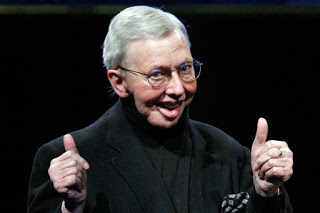
Not since the 2008 passing of former Meet the Press moderator, seasoned journalist and accomplished author Tim Russert has the death of a celebrity or public figure hit me this hard. I am referring of course, to the sad news of legendary film critic Roger Ebert’s expiration yesterday, following a long and public battle with various cancers. I spent most of last evening drinking wine and reading some of Ebert’s classic meditations on the afterlife and the collapse of Chicago’s once grand movie palaces through sorrowful tears. As was the case with Mr. Russert’s untimely demise, I felt bereft, quite as if a friend or family member I knew intimately had left a gaping wound that could only be treated by traveling backward and savoring the witty, intellectual memories.
During the course of this binge, I ran into an essay Ebert wrote for The Wall Street Journal in 2010. Entitled “Why I Loathe Top 10 Film Lists,” it turns out that the man who rose to fame in part for his ability to determine quality via rank, actually had no taste for the task. But among many wonderful attributes the icon possessed, a sense of humor was decidedly one of them. So it is with a purposeful mix of gratitude, respect and good-natured ribbing that I present my parting gift to the man whose erudite musings on film, politics, pop culture and life in general will inspire my own work for as long as I am able to do it.
The Top 10 Things I Learned from Roger Ebert
1. Be a Lifelong Student
Did you know that Ebert was a doctoral candidate at the University of Chicago in the 1960s, studying English Literature, even while employed as a general reporter for the Sun-Times? I didn’t until yesterday and dammit, this little nugget only increased my respect. But beyond traditional academic learning, the critic was a pupil of the world. Long after he lost his audible voice, Ebert was still looking for information and answers to some of life’s greatest mysteries. Complacency and arrogance are boring and lead to mental stagnation. He understood this – a huge reason his work continued to connect across a career that spanned nearly half a century.
2. Writers May Enjoy Diverse, Satisfying Careers Without Moving To New York City or L.A.
Robert Ebert was born and raised in Urbana, IL, enjoyed most of his career highlights in the Windy City and literally put Chicago on the film criticism map. To this day, most aspiring writers are under the impression that a stint in the traditional publishing and Hollywood scriptwriting centers is the only way to be “seen.” Ebert did it his way and in process, collected a Pulitzer Prize, a hit syndicated television program and millions of enthusiastic readers. Following his example, I have cultivated a four-year freelance theater criticism career – over 700 miles away from Broadway.
3. Late Bloomers Rock
I didn’t get my first period until I was almost 15 years old, kept growing until I was 20, had my braces removed at age 31 and didn’t form a functional adult romantic relationship until I was 33. As odd as these delayed milestones sometimes made me feel, I was in good company. Because my hero Roger Ebert segued into the genre that made him famous only after trying and discarding several other journalism ventures. He also married the love of his life, wife Chaz, at the ripe old age of 50.
4. Collaborating with Rivals Can Be Inspiring
Ebert famously said that when he was originally asked to co-anchor the popular show that eventually became At the Movies with his contemporary, Chicago Tribune critic Gene Siskel, he had little inclination to team up with “the most hated guy in my life.” Imagine all we would have missed had Ebert not reconsidered. Taking a page from Abraham Lincoln’s formula for greatness, Ebert was self-aware and gracious enough to comprehend that butting heads with adversaries produces the need to consider and articulate one’s viewpoint in ways that surrounding oneself with sycophants cannot.
5. You Can Have Strong, Divisive Opinions and Still Be Universal
This claim would seem to be an oxymoron in the overly politicized and hyper partisan 21st century, but Ebert personified it. An avowed atheist and liberal as well as a stinging pundit gifted with a turn of phrase, the icon nonetheless engendered almost universal esteem. Film director David Wain, a frequent target of Ebert’s negative reviews, still felt compelled to tweet: “Roger Ebert was an ongoing inspiration (if not always a fan) to me and I am truly, truly saddened by his loss. I will miss him.”
6. Be Human First
While Ebert made a livelihood out of sharing his unvarnished opinions with the masses, he was never cruel. The legend always understood that real people stood behind a piece of work – people with thoughts, feelings and emotions who poured themselves into a finished product, no matter how wobbly. As producer Chris Weitz said yesterday, “Rest in Peace, Roger Ebert. You were a gentleman. Sometimes loved my movies, sometimes hated them, but you were always fair.”
7. Step Outside Your Comfort Zone
If he so chose, Roger Ebert could have played it safe. As a beloved critic and public figure, there was absolutely no reason for him to risk popular rejection by accepting director Russ Meyer’s 1970 commission of the screenplay for cult film Beyond the Valley of the Dolls. But he did it anyway, and even though the movie was almost universally panned upon its release, Ebert harbored no regrets. According to a report in the New York Times, “the film seemed a point of pride for Mr. Ebert, who was paid $15,000 and never tired of talking about it.”
8. Embrace Change
At the time of his death, Ebert had over 800,000 Twitter followers and was a frequent tweeter. He had an active Facebook fan page and was an avid blogger. It is important to remember that the man was 70 years old and began his career when “status updates” meant pulling out the electric typewriter and mailing the finished product via USPS. Ebert, rather than running scared from New Media, used it to share his topical musings and promote his brand, even after cancer had deprived him of the ability to speak. By jumping into the 21st century with both feet, Ebert was able to regain his voice.
9. Physical Challenges Are Only Limiting As You Allow
See above. And there’s this: two days before his death, Ebert took to his blog to announce a “leave of presence,” that included never-realized plans to continue reviewing the films he loved. It seems he never got the memo that illness and disfigurement require you to retreat and watch life happen from the sidelines. Literally nothing short of dying could get between Ebert and his work.
10. When You Can’t Talk About Anything Else, There’s Always the Movies
There are many good reasons why it’s best to steer clear of religion and politics as conversation topics in mixed company. But everyone has an opinion about film and, should discourse come to a screeching halt, they’ll be more than happy to share them.
On a personal note, Ebert’s annual film review anthologies offered me a platform for connecting with a confusing father when it often seemed impossible. Overrun by mental illness and debilitating addictions which included gambling and hoarding, sports and a love of film were the links that bonded my dad with a daughter desperate for common ground.