La Ruta

The cast of ‘La Ruta’ at Steppenwolf Theater Company. (Photo: Michael Brosilow)

“With the world premiere production of La Ruta, written by Chicago playwright Isaac Gomez, the theater company burnishes its progressive reputation with another bold, beautiful and timely piece of art. A late 2018 look at the recent, intersectional history of North American trade, gender dynamics, gang warfare, and their collective impact on personal freedoms, director and ensemble member Sandra Marquez leads a stunningly talented all-female cast to an unmitigated dramatic victory.

It’s the late 1990s and NAFTA has created new opportunities and threats for the women living in Mexican border towns. Many of them make arduous bus commutes to work long hours for little pay in U.S.-owned factories. La Ruta — inspired by real testimonies — allows audiences to drop in on the stressful demands that keep them fighting, laughing, singing and working, while unseen men administer a metastasizing culture of fear, corruption and violence that clings to the periphery of every word and action.

In this Steppenwolf production, most of the live music is offered by guitarist, singer and actress Laura Crotte (Desamaya) who leads her fellow cast members through poignant, piercing musical interludes interwoven through the play’s action. A trobairitz (the feminine troubadour) for the late 20th century, the combination of Ms. Crotte’s musical gifts and acting talents result in a stunning visual soundtrack that penetrates the eyes and ears. Audiences are initially drawn in, then bid goodnight by the performer’s siren calls for love, peace and justice. There were more than a few misty eyes in the audience after this week’s first press opening, a testament to La Ruta’s powerful combination of song and drama.”

Read the complete review on The Broadway Blog.

Familiar

(l to r) Cedric Young, Celeste M. Cooper, Ora Jones, Lanise Antoine Shelley, and Jacqueline Williams in ‘Familiar.’ (Photo: Michael Brosilow)

“Danai Gurira has built a Hollywood brand playing characters known for their physical and mental strength. In television shows such as AMC’s The Walking Dead, and blockbuster films like 2018’s Black Panther, Ms. Gurira commands attention with portraits of women who can love and be loved, while also kicking ass and making important decisions. Ms. Gurira has become an icon for the #MeToo era as women work to create safer, more powerful and public spaces for themselves, as well as a global HIV advocate. Who among us hasn’t fantasized about going full General Okoye on a street harasser?

Yet I confess that until recently, I was unaware of Ms. Gurira’s accomplishments as a prolific and celebrated playwright. Is there nothing this woman can’t do? I’m an excited fangirl all over again after attending the opening of Steppenwolf Theatre Company’s newest production, a mounting of Ms. Gurira’s 2015 play, Familiar. With humor, sharp dialogue, physical comedy and, not incongruently, large helpings of emotional heft, the work engages questions of identity, family dynamics, and the immigrant experience.

All productions as successful as this one start with great source material. Familiar drops in on the Chinyaramwira family, Zimbabwe-Americans living in Minnesota. In climate and culture, the Midwestern locale couldn’t be more different from life in the African nation, and Ms. Gurira looks at a wide scope of contrasts with remarkable balance. For every obvious benefit of material wealth and comfort, the play argues, there’s a tradeoff. These various concessions are explored through the play’s philosophically diverse characters, and they are brought together through an enduring trope of emotional volatility: the family wedding.”

Read the full post at The Broadway Blog.

An Oak Tree

Gage Wallace in Red Theater’s ‘An Oak Tree.’ (Photo: Matt Wade)

“Red Theater Chicago’s production of An Oak Tree has a lot of good ideas. Written as it were by Tim Crouch, the semi-improvisational script tackles themes of loss, guilt and the ways one might manipulate reality to manage overwhelming experiences. It also leverages a handy and creative metaphor for that exploration.

Featuring Gage Wallace as First Actor, or Hypnotist, the play’s action occurs a year after a tragedy for which the Hypnotist is partly responsible. The family-friendly practitioner of the occult has lost his mojo, a development he reveals honestly and exhaustedly to his latest audience. When the Hypnotist seeks volunteers to participate in his ‘act’ (word very carefully chosen), his eyes fall upon a man he does not recognize, but should. Without giving away spoilers, the actor who takes a seat upon the Hypnotist’s stage is intimately involved in last year’s tragedy, and the two characters begin a cerebral, transcendental verbal dance that slowly exposes their respective suffering.

Here’s the script’s creative rub. Second Actor, or the individual who raises his or her hand to be hypnotized, is played each night by a different performer. Per An Oak Tree’s press packet, ‘the second actor will discover the play and their role at the same time as you [audience members] do.’ Actors and actresses who’ve agreed to take on the role are announced the Tuesday before the production’s weekend performances.”

Read the full post at The Broadway Blog.

Wife Material

(l to r) Caitlin Dobbins, Jamie Shriner and Natalie Rae in Underscore Theatre Company’s ‘Wife Material.’ (Photo: Joe Underbakke)

“The work begins promisingly, casting Shriner as a small-town, high school show choir nerd who loses her virginity to an elusive, emotionally unavailable boyfriend. While the man-child proves disposable, Shriner’s love for the sexual chase and experience becomes one of the “10,000 pieces” that compromise her character. Branded by her peers in Indiana, and into her undergraduate college years at Millikin University in Central Illinois as a “bad” girl of dubious morals, Shriner makes the (seemingly) conscious decision to let her freak flag fly.

But then a #MeToo reckoning is squeezed into a momentum-slowing fashion between its riotous setup and compromising denouement. While painfully authentic and emotional, the sudden pivot to a plotline involving a past sexual assault undercuts what is previously served up as a narrative of female agency. As a feminist writer who urgently believes that more complicated, messy stories for and by women are needed across the entertainment spectrum, it pains me to see the production’s structure as an inadvertent capitulation to the very patriarchy it critiques. The subsequent upshift to a final 10 minutes of sex comedy ends with Shriner’s proscripted, heteronormative conclusion. It’s not what we’re lead to expect and it feels like a cheat.”

Read the full post at The Broadway Blog.

Crumbs from the Table of Joy

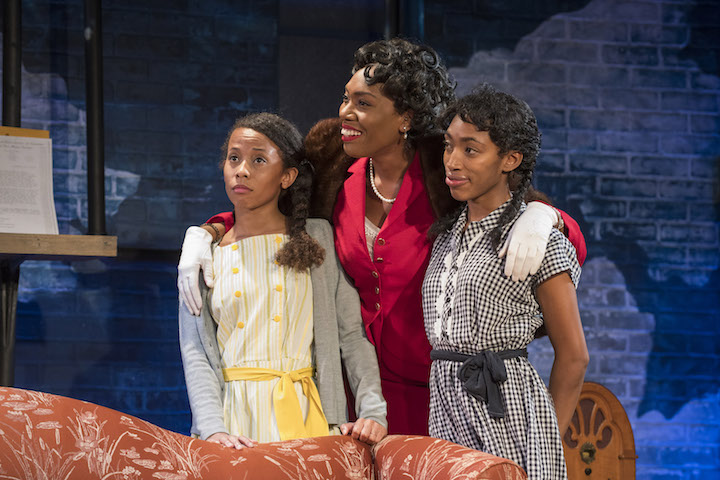
(l to r) Brandi Jiminez Lee, Brianna Buckley and Chanell Bell in Raven Theatre’s ‘Crumbs From the Table of Joy.’ (Photo: Michael Brosilow)

“The script from two-time Pulitzer Prize-winner Lynn Nottage (2009’s Ruined and 2017’s Sweat) also leaves open the distinct and tantalizing possibility that his wife’s ghost isn’t the only spirit Godfrey is fleeing. Lily, sister of the deceased, makes a reappearance on the relocated Crump doorstep that leaves everyone breathless. Loud, unabashed and full-on woke, in an era when Jim Crow laws and separate-but-equal instructed African-Americans to “know their place,” Lily is unafraid to take up space and speak her mind. For the damaged Crump family, this is both enticing and threatening.

The unvoiced dialogue between Godfrey and Lily is suggestive of a more complicated and intertwined past between the two. Their immediate and still-palpable chemistry sends Godfrey fleeing in yet another direction — right into the chaste arms of Gerte (Emily Tate), a recent white, German immigrant that Godfrey meets on the subway. Charmed by her submissiveness and willingness to follow the teachings of the never-seen Father Devine, Godfrey impulsively marries Gerte and installs her in his crowded and emotionally charged Brooklyn basement flat.

Within the cramped rooms of the Crump apartment, religious, racial and sexual tensions flare as Ernestine prepares to graduate high school and transition to adulthood. While all of the cast members acquit themselves well and present the audience with a complicated and authentic slice of Eisenhower-era Americana, it is Ms. Buckley who completely commands our rapt attention.”

Read the fill post at The Broadway Blog.